
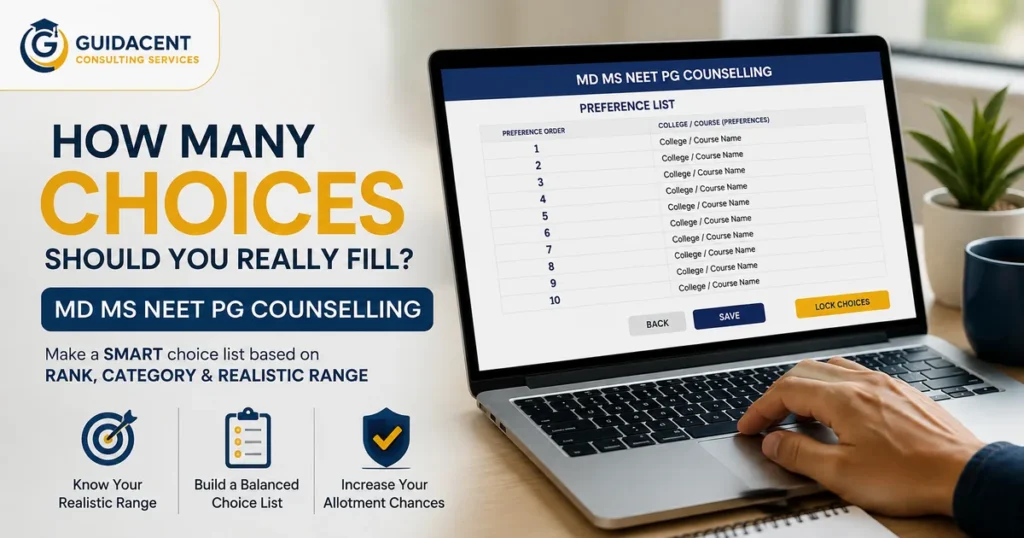
How Many Choices Should You Fill in MD/MS NEET PG Counselling?
There is no single fixed number of choices that works for every NEET PG candidate. Your ideal preference list should depend on your NEET PG rank, category, preferred MD/MS branch, college type, fee budget and realistic admission range. A well-planned choice list can help you participate more effectively in counselling.
Personalised guidance can help you understand your options, but admission and seat allotment depend on eligibility, rank, preferences, seat availability and the applicable counselling authority.
Introduction:
Every counselling season, a common question comes up right before choice filling opens: how many choices to fill in MD MS NEET PG counselling actually matters for your allotment. Some candidates fill five or six “safe” options and stop. Others try to add every possible combination without any real order. Both approaches create avoidable risk, especially for candidates with moderate ranks who cannot afford to run out of realistic options mid-round.
This matters because your allotment depends entirely on what you submit. If your list is too short and none of your choices are available at your rank, you may end up with no seat in that round — even though a seat you would have accepted was allotted to someone else.
How Many Choices Should You Fill in NEET PG Counselling?
The Medical Counselling Committee (MCC) does not prescribe a fixed maximum or minimum number of choices. However, its counselling guidance advises candidates to fill around 30–40 choices.
There is no universal “correct” number of choices. The right length of your MD/MS preference list depends on your NEET PG rank, category, budget, preferred branch, college preferences and the number of options you would genuinely be willing to accept if allotted.
MD/MS NEET PG Choice Filling: What to Remember
-
MCC allows candidates to submit as many choices as permitted by the counselling portal. The commonly cited 30–40 choices is advisory guidance, not a mandatory minimum or maximum.
-
State counselling rules can differ. Many state authorities allow candidates to enter multiple preferences, but always verify the current counselling bulletin and choice-filling instructions for your specific state.
-
An unnecessarily short preference list can reduce your allotment opportunities. You may receive no seat in a round even though other seats you would have accepted were available but were not included in your submitted choices.
-
Never add choices simply to make your list longer. Every college, course and seat category you select should be an option you would genuinely consider accepting if allotted.
-
Review and reorder your preferences carefully before locking. Choices can generally be modified during the permitted choice-filling period, but once choices are locked or the applicable deadline passes, changes may no longer be possible under that round’s rules.
WHAT MCC ACTUALLY SAYS ABOUT CHOICE FILLING LIMITS
Candidates preparing their list should first understand the complete MD MS admission and counselling process in India, since choice filling is only one stage within registration, seat allotment, document verification and reporting.
Within the MCC NEET-PG counselling bulletin, one FAQ addresses this directly: candidates may submit as many choices as they wish, in order of preference, and allotment follows that order based on merit and seat availability. The same answer adds a practical suggestion — filling around 30 to 40 choices is advisable for most candidates. This is guidance, not an enforced limit; MCC has not published a hard cap in its published counselling scheme.
State counselling authorities, including bodies like the Karnataka Examinations Authority for state quota seats, generally follow a comparable approach and do not enforce a fixed number either. Because state rules can be revised each session, candidates should confirm the current bulletin for the specific authority they are registering with before finalising their strategy.
WHY A SHORT CHOICE LIST IS RISKIER THAN IT LOOKS
A short list feels manageable, but it works against you in a merit-and-preference system. If none of your five or six choices are available at your rank in a given round, you simply get no seat that round — you are not automatically moved to a different, unlisted option.
This becomes more serious across rounds. Vacancy patterns shift after Round 1 as candidates upgrade, resign or fail to report. Choices that were unrealistic in Round 1 sometimes open up in Round 2, Round 3 or the stray vacancy round. A list built only around your Round 1 expectations misses these later opportunities unless you refile choices for each fresh round.
HOW TO DECIDE THE RIGHT NUMBER FOR YOU
Rather than aiming for a specific figure, build your list around three layers, and let the count emerge from that process.
Aspirational:
What it contains: Colleges/branches slightly above your expected range, worth trying
Typical share of your list: Smaller share, placed first
Realistic:
What it contains: Options closely matched to your rank, category and quota history
Typical share of your list: Largest share
Acceptable fallback:
What it contains: Options you would genuinely join if nothing else is allotted
Typical share of your list: Moderate share, placed last
A candidate targeting only AIQ seats in a few clinical branches may reasonably need fewer choices than a candidate also exploring state quota, deemed universities and multiple non-clinical branches. The number is a byproduct of how wide your acceptable range is — not a target to hit for its own sake.
A Simple Checklist Before You Finalise the Count
- Would you actually join every seat on this list if it were the only one allotted?
- Have you included options across more than one round’s realistic range, not just Round 1?
- Does the list reflect your actual budget, including management or NRI quota fee levels where relevant?
- Have you checked eligibility for every state or category-specific choice you’ve added?
- Is the order genuinely your preference order, not just alphabetical or copied from someone else’s list?
EXPERT COUNSELLOR’S INSIGHT
A longer list is not inherently better — a long list of choices you would never actually join wastes effort and adds confusion. The more useful question is whether your list covers your full realistic range across rounds, categories and quotas you are eligible for. Candidates with average or borderline ranks generally benefit from a wider list than those with very high ranks chasing a narrow set of top colleges, simply because their realistic range is broader.
COMMON MISTAKES TO AVOID
- Stopping at a small number of “dream” choices and skipping realistic or fallback options entirely.
- Copying a friend’s choice list without adjusting for your own rank, category and eligibility.
- Listing a college or branch you would not actually join, just to make the list longer.
- Ignoring state quota or deemed university options because AIQ is the default focus.
- Waiting until the last day to fill choices, leaving no time to research or correct errors before locking.
WHAT STUDENTS SHOULD DO NEXT
- Check the current MCC or relevant state bulletin for this session’s choice filling rules before assuming last year’s advisory still applies.
- List every branch and college combination you would accept, then sort into aspirational, realistic and fallback layers.
- Verify eligibility, fee structure and bond conditions for every choice before adding it, especially for deemed university or NRI options.
- Review and reorder your list at least once before the locking deadline — do not submit on the final day.
- Seek personalised counselling if you are unsure how wide your realistic range should be across states, quotas or categories.
OFFICIAL SOURCES
This article’s guidance on choice filling rules is based on the NEET-PG (MD/MS/DNB) Counselling 2025 Information Bulletin and Counselling Scheme published by the Medical Counselling Committee (MCC), DGHS (https://cdnbbsr.s3waas.gov.in/s3e0f7a4d0ef9b84b83b693bbf3feb8e6e/uploads/2025/10/202510181022788907.pdf). As of the current date, MCC has not published a separate 2026 information bulletin, since NBEMS’s notice on NEET-PG 2026 (https://natboard.edu.in/viewNotice.php?NBE=aS91U2J0Q1NJSStyKzJROEFETS9UUT09) schedules the exam for 30 August 2026 and the result by 30 September 2026. The 2025 bulletin is referenced here only for its choice-filling process guidance, which candidates must reverify against the 2026 bulletin once released.
FREQUENTLY ASKED QUESTIONS
Is there a maximum number of choices allowed in MD/MS counselling?
No fixed maximum exists in the MCC counselling scheme. Candidates may submit as many choices as they wish, though MCC’s own bulletin advises around 30–40 as a practical guideline. State authorities generally follow a similar approach, but you should confirm the current bulletin for your specific counselling authority.
Is there a minimum number of choices you should fill?
No official minimum is set, but filling only a handful of choices increases the chance of getting no seat in a given round. There is no requirement to reach any particular number — the list should simply cover every option you would genuinely accept.
Can I add more choices after locking them?
No. Once choices are locked for a round, they cannot be modified for that round. You can add, edit or reorder choices only before the locking deadline, and a fresh, separate choice list is usually required for each new round.
Does filling more choices reduce my chance of getting a higher-preference seat?
No. Allotment follows your stated order of preference along with merit and seat availability. Adding fallback choices lower in your list does not affect whether higher-preference choices are considered first.
Should I fill the same number of choices in every round?
Not necessarily. Vacancy positions change between rounds as candidates upgrade or exit, so your realistic range may widen or narrow. Review the updated seat matrix before each round and adjust your list length accordingly, rather than reusing an earlier round’s choices unchanged.
Do state quota counselling authorities have different rules on choice numbers?
Most major state authorities also allow a broad number of choices without a fixed cap, but exact rules can vary by state and by session. Always check the specific state authority’s current information bulletin rather than assuming AIQ rules apply uniformly.
CONCLUSION
There is no single right answer to how many choices to fill in MD MS NEET PG counselling — MCC’s own guidance of 30–40 is a starting reference, not a rule you must follow exactly. What matters more is whether your list genuinely covers your realistic range across rounds, quotas and categories you’re eligible for, without padding it with options you would never actually join.
If you’re unsure how wide your list should be given your rank, category and state options, personalised counselling support can help you map this out before choice filling opens.
Need Personalised MD MS Admission Guidance?
Speak with Guidacent Consulting Services for assistance with NEET score analysis, college shortlisting, counselling strategy, fee comparison and document verification.
Website: Guidacent Consulting Services
Guidance can help you understand your admission and counselling options. Seat allotment and admission depend on NEET PG eligibility, rank, preferences, seat availability and the rules of the applicable counselling authority.
Written by
Ssunny Yadav
Founder – Guidacent Consulting Services Pvt. Ltd.
12+ year’s experience in Engineering | Medical | Management | Admission Guidance in Top colleges of India & Abroad