
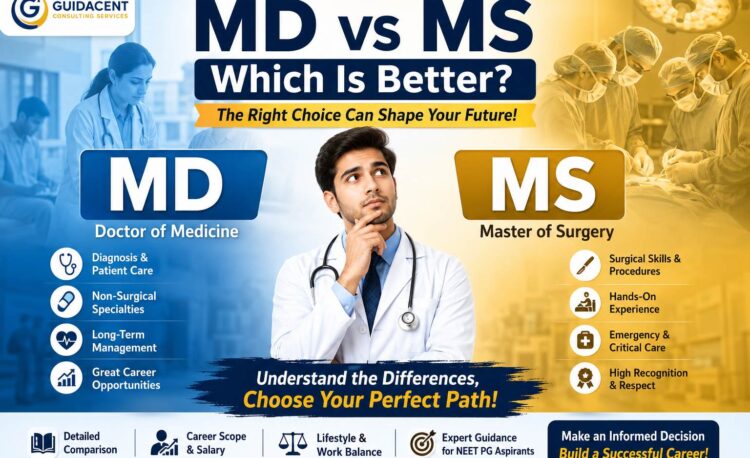
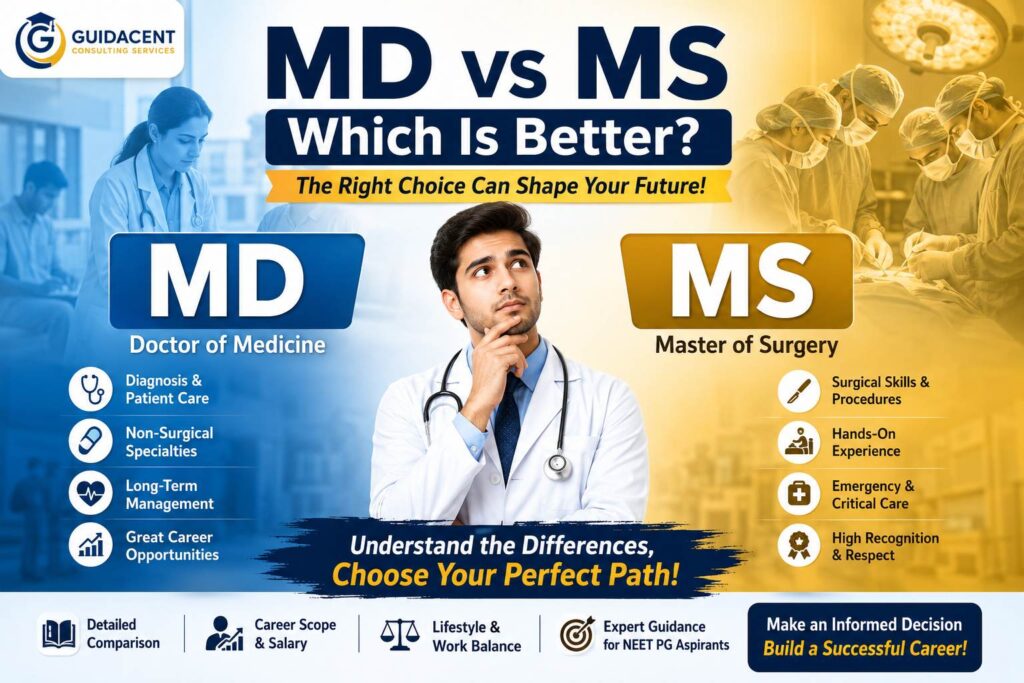
MD vs MS: Which Is Better? A Complete Career Decision Guide for Future Specialists
A practical, counselling-focused guide for NEET PG aspirants comparing MD and MS after MBBS.
Introduction: The Decision That Can Shape the Next 30 Years of Your Medical Career
Every year, thousands of MBBS graduates reach a crucial crossroads after NEET PG results are announced.
Many students focus entirely on rank, seat availability, and counselling rounds. However, a far bigger question often remains unanswered:
Should I choose MD or MS?
At first glance, the answer appears simple.
MD is associated with non-surgical specialties.
MS is associated with surgical specialties.
However, the reality is far more complex.
The choice between MD and MS can influence your future lifestyle, earning potential, patient interaction, superspeciality opportunities, work-life balance, academic interests, stress levels, and long-term career satisfaction.
Unfortunately, many students make this decision based on myths.
Some believe surgeons earn more.
Others assume physicians enjoy better lifestyles.
Many select a branch purely because relatives recommend it.
Some choose a specialty simply because their rank allows it.
Years later, many realize they selected the wrong path.
As a medical admission counselor, I have spoken with hundreds of MBBS graduates who later admitted they never truly understood the difference between MD and MS before making their preference list.
That is exactly why this guide exists.
This article goes beyond generic comparisons found on education portals.
Instead, it provides practical insights, counselling guidance, career realities, and decision-making frameworks that help future specialists make informed choices.
Whether you dream of becoming a cardiologist, dermatologist, pediatrician, orthopedic surgeon, neurosurgeon, or gynecologist, this guide will help you understand where you fit best.
There is no universally better option between MD and MS. MD is ideal for students interested in diagnosis, clinical medicine, long-term patient management, and superspecialities such as cardiology, dermatology, and radiology. MS is better for students who enjoy surgery, procedures, operating theatres, and hands-on treatment. The best choice depends on personality, interests, career goals, lifestyle preferences, and aptitude rather than perceived prestige.
What Is the Difference Between MD and MS?
MD and MS are postgraduate medical degrees pursued after MBBS. MD focuses primarily on medical diagnosis, disease management, and non-surgical treatment. MS focuses on surgical procedures, operative skills, and surgical patient care. Both are recognized by the National Medical Commission and offer excellent career opportunities.
The most fundamental distinction lies in how patients are treated.
A physician typically treats patients using medicines, investigations, monitoring, and long-term management.
A surgeon treats patients through procedures and operations.
However, this explanation only scratches the surface.
MD stands for Doctor of Medicine.
MS stands for Master of Surgery.
During postgraduate training, MD candidates spend most of their time learning disease diagnosis, patient evaluation, medical management, and evidence-based treatment protocols.
MS candidates focus heavily on surgical techniques, operation theatre exposure, procedural skills, emergency surgeries, and postoperative care.
Both paths require dedication, hard work, and lifelong learning.
Neither is inherently superior.
The real question is:
Which aligns better with your personality and professional aspirations?
Students exploring MD MS Admission in India often focus entirely on branch cutoffs while ignoring this crucial aspect.
That mistake can lead to career dissatisfaction later.
For a complete understanding of postgraduate seat selection and branch planning, students should review this detailed MD MS Admission Process guide:
Why Students Get Confused Between MD and MS
The confusion usually begins during internship.
Many interns rotate through departments for only a few weeks.
As a result, they see only a limited snapshot of each specialty.
They observe busy surgeons in the operation theatre.
They observe physicians conducting ward rounds.
However, they rarely see what happens years later.
For example:
A successful dermatologist may earn more than many surgeons.
A radiologist may enjoy significantly better work-life balance.
An orthopedic surgeon may have greater procedural independence.
A pediatrician may build stronger long-term patient relationships.
Therefore, comparing MD and MS as broad categories often becomes misleading.
The real comparison should involve:
- Personal interests
- Lifestyle goals
- Academic strengths
- Stress tolerance
- Career vision
- Long-term satisfaction
MD vs MS: Core Differences Explained
MD is centered on medical science and disease management, whereas MS revolves around surgery and procedural intervention. Students who enjoy analytical thinking, diagnosis, and long-term patient care often prefer MD. Those who enjoy hands-on procedures, emergency decision-making, and surgical precision generally thrive in MS specialties.
Nature of Work
MD doctors spend a significant portion of their day:
- Diagnosing illnesses
- Interpreting reports
- Planning treatment
- Managing chronic diseases
- Counseling patients
MS specialists spend much of their day:
- Performing surgeries
- Managing emergencies
- Conducting procedures
- Handling operative complications
- Providing surgical follow-up care
Skill Requirements
MD demands:
- Clinical reasoning
- Analytical thinking
- Interpretation skills
- Diagnostic expertise
MS demands:
- Manual dexterity
- Surgical precision
- Hand-eye coordination
- Quick procedural decision-making
Daily Lifestyle
Physicians often spend more time in OPDs and wards.
Surgeons often spend more time in operation theatres.
Emergency calls can occur in both fields, although surgical branches may involve more unpredictable schedules.
Which Degree Has Better Career Scope?
Both MD and MS offer excellent career opportunities. Career scope depends more on the chosen specialty than on the degree itself. High-demand MD specialties include Radiology, Dermatology, General Medicine, and Pediatrics. High-demand MS specialties include Orthopedics, General Surgery, ENT, Ophthalmology, and Obstetrics & Gynecology.
One of the biggest misconceptions among NEET PG aspirants is that MD automatically provides better opportunities.
This is not true.
Certain MS specialties outperform several MD branches financially.
Similarly, some MD specialties offer superior work-life balance and earning potential compared to surgical fields.
The healthcare landscape in India is evolving rapidly.
Demand is increasing across:
- Internal Medicine
- Radiology
- Dermatology
- Pediatrics
- Psychiatry
- Orthopedics
- General Surgery
- Ophthalmology
Students reviewing the broader MD MS Counselling Guide often discover that specialty selection influences career outcomes far more than the MD versus MS label itself.
For detailed counselling insights, students can explore:
Which Has Higher Salary Potential?
Salary depends primarily on specialty, location, experience, reputation, and practice model. Some MD branches such as Radiology and Dermatology can generate exceptionally high earnings. Similarly, MS branches like Orthopedics, Neurosurgery, and Surgical Gastroenterology can produce substantial income. There is no universal salary advantage for MD or MS.
Many students choose specialties solely based on income expectations.
This approach often backfires.
A specialty should align with your interests because long-term success depends heavily on passion and consistency.
That said, salary remains an important consideration.
Several factors influence earnings:
- City
- Hospital type
- Private practice
- Corporate sector opportunities
- Academic involvement
- Superspeciality training
A highly skilled physician can earn significantly more than an average surgeon.
Similarly, an experienced surgeon may earn far more than many non-surgical specialists.
Therefore, the question should not be:
"Which earns more?"
Instead ask:
"Which specialty can I excel in over the next twenty years?"
The highest earners in medicine are usually specialists who combine expertise, reputation, patient trust, and procedural skills. The degree itself does not determine income. Long-term excellence does.
Confused Between MD and MS?
Get practical counselling guidance for branch selection, preference list planning, seat strategy, and long-term career suitability.
Which Offers Better Work-Life Balance?
This is one of the most searched questions among postgraduate medical aspirants.
Students increasingly prioritize:
- Family life
- Mental health
- Personal time
- Flexible schedules
- Professional satisfaction
The assumption that all MD branches have excellent work-life balance is incorrect.
Similarly, not every MS branch involves endless emergencies.
Reality is more nuanced.
Some specialties are naturally more demanding.
For example:
Emergency-heavy fields require frequent night duties.
High-volume surgical specialties may involve unpredictable schedules.
Conversely, some specialties provide more structured working hours.
Students who value predictable routines often consider this factor heavily while preparing their MD MS Admission Process strategy.
Work-life balance varies by specialty rather than degree. Some MD branches such as Dermatology and Radiology may offer highly predictable schedules. Certain MS branches can involve more emergency calls and operative commitments. Students should evaluate lifestyle preferences before selecting a specialty.
Is MD Easier Than MS?
One of the most persistent myths in postgraduate medical education is that MD is easier.
The reality?
Neither degree is easy.
They are difficult in different ways.
MD challenges students intellectually.
MS challenges students technically.
An MD resident may spend hours analyzing complex cases, reviewing investigations, and managing critically ill patients.
An MS resident may spend hours in surgery, learning procedural techniques, and managing surgical emergencies.
The stress exists in both paths.
The nature of the stress differs.
Students who dislike operative work often struggle in MS.
Students who dislike extensive clinical analysis often struggle in MD.
Therefore, difficulty should never be the deciding factor.
Suitability should.
If you are confused between MD and MS, spend time evaluating your interests rather than looking at cutoffs. Ask yourself whether you enjoy diagnosis or procedures, ward rounds or operation theatres, long-term patient relationships or surgical intervention. Your natural inclination often reveals the correct choice.
Many students preparing preference lists under the MD MS Admission framework make decisions based solely on rank.
This is risky.
Before locking choices, ask:
- Do I enjoy surgery?
- Can I handle operation theatre pressure?
- Do I prefer diagnostic challenges?
- Do I enjoy procedural work?
- What lifestyle do I envision at age 40?
- Do I want superspeciality training?
These questions often reveal the answer more clearly than any ranking table.
Common Myth #1: Surgeons Always Earn More Than Physicians
This myth continues to influence counselling decisions every year.
The reality is far different.
Modern healthcare has transformed earning patterns.
Today:
- Radiologists command premium fees.
- Dermatologists run successful practices.
- Gastroenterologists generate substantial revenue.
- Cardiologists remain highly sought after.
Income depends on expertise, demand, and reputation—not merely whether the degree says MD or MS.
Common Myth #2: MD Is Better for Girls and MS Is Better for Boys
This outdated belief has no place in modern medicine.
Today, women excel across:
- Orthopedics
- Neurosurgery
- Surgical Oncology
- General Surgery
- Urology
Likewise, men thrive in traditionally non-surgical specialties.
The best specialty is determined by aptitude and interest, not gender.
Common Myth #3: Choosing MD Means No Procedures
Another misconception is that MD specialists only prescribe medicines.
Several MD specialties involve significant procedural work.
Examples include:
- Cardiology
- Gastroenterology
- Pulmonology
- Critical Care
- Interventional Radiology
Medicine today is increasingly procedure-oriented.
Therefore, students should evaluate individual specialties rather than broad labels.
MD vs MS Branch-Wise Comparison: Looking Beyond the Degree Name
One of the biggest mistakes I see among NEET PG aspirants is comparing MD and MS as if they are two single specialties.
In reality, comparing MD and MS is like comparing an entire fruit basket with another fruit basket.
Each contains multiple options.
Each specialty has its own opportunities, challenges, earning potential, and lifestyle.
For example, comparing MD Dermatology with MS General Surgery makes far more sense than comparing MD and MS broadly.
The degree title matters.
However, the branch matters much more.
That is why experienced counselors focus first on specialty suitability and only then on the degree category.
Let's examine some common comparisons students frequently ask about.
MD General Medicine vs MS General Surgery
MD General Medicine is ideal for students who enjoy diagnosis, clinical reasoning, and long-term patient management. MS General Surgery suits students who enjoy procedures, operating theatres, emergency decision-making, and hands-on treatment. Neither is better universally; the right choice depends on individual interests and career goals.
These two specialties remain among the most respected postgraduate medical branches in India.
MD General Medicine
Students spend years mastering:
- Clinical diagnosis
- Internal diseases
- Critical care
- Chronic disease management
- Complex medical conditions
Physicians often become the first point of contact for patients.
They frequently coordinate multidisciplinary care.
Many later pursue superspecialities such as:
- Cardiology
- Neurology
- Nephrology
- Endocrinology
- Gastroenterology
MS General Surgery
General surgeons develop expertise in:
- Surgical procedures
- Trauma management
- Emergency surgeries
- Operative planning
- Post-operative care
Many eventually pursue:
- Surgical Oncology
- Plastic Surgery
- Urology
- Pediatric Surgery
- Gastrointestinal Surgery
Students reviewing the broader MD MS Counselling Guide often discover that both specialties provide tremendous growth opportunities.
The better option depends entirely on whether you enjoy solving diagnostic puzzles or performing surgical interventions.
For a deeper understanding of specialty planning within postgraduate medical education, students can explore the comprehensive MD MS Admission in India resource:
MD Radiology vs MS Orthopedics
This comparison has become increasingly common over the last decade.
Both specialties attract highly competitive ranks.
However, the day-to-day work differs dramatically.
MD Radiology
Radiologists spend most of their time:
- Interpreting imaging studies
- Reporting scans
- Assisting diagnosis
- Supporting clinical teams
Benefits include:
- High demand
- Strong private sector opportunities
- Growing technological advancements
- Better schedule predictability
Challenges include:
- Continuous reporting pressure
- Need for accuracy
- Long hours of screen-based work
MS Orthopedics
Orthopedic surgeons focus on:
- Fracture management
- Joint replacements
- Sports injuries
- Trauma care
- Reconstructive procedures
Benefits include:
- High procedural volume
- Strong patient impact
- Excellent private practice opportunities
Challenges include:
- Physical workload
- Emergency duties
- Long surgeries
Both branches remain excellent choices.
The deciding factor should be personality rather than popularity.
MD Dermatology vs MS Obstetrics & Gynecology
Few specialty comparisons illustrate lifestyle differences better than this one.
MD Dermatology
Dermatology has gained immense popularity because it offers:
- Predictable working hours
- Cosmetic practice opportunities
- Strong patient demand
- High satisfaction rates
However, success requires:
- Patient communication skills
- Practice-building abilities
- Continuous learning
MS Obstetrics & Gynecology
OBG is among the most rewarding specialties in medicine.
It combines:
- Surgery
- Women's health
- Emergency management
- Long-term patient relationships
At the same time, it demands:
- Night duties
- Labor room emergencies
- High responsibility
Students frequently select one of these branches based purely on perceived lifestyle advantages.
That approach often leads to dissatisfaction later.
Choose the field that excites you, not the field that appears easier.
Which Branches Are Growing Fastest in India?
The fastest-growing medical specialties in India include Radiology, Dermatology, Emergency Medicine, Critical Care, Psychiatry, Cardiology, Orthopedics, Oncology, Gastroenterology, and Minimally Invasive Surgery. Demand is driven by lifestyle diseases, aging populations, technology adoption, and healthcare expansion.
Healthcare trends are changing rapidly.
India's disease burden is evolving.
As a result, several specialties are experiencing unprecedented growth.
These include:
- Radiology
- Psychiatry
- Critical Care
- Oncology
- Cardiology
- Neurology
- Endocrinology
- Orthopedics
- Gastroenterology
Students should understand future healthcare demand before finalizing preferences.
A specialty with strong future demand often provides greater career security.
How Superspeciality Opportunities Influence the MD vs MS Decision
Many students focus only on the next three years.
However, experienced doctors often think fifteen years ahead.
That is where superspeciality pathways become important.
Superspeciality opportunities can significantly influence the MD versus MS decision. MD graduates can pursue DM programs such as Cardiology, Neurology, and Gastroenterology. MS graduates can pursue MCh programs such as Urology, Neurosurgery, and Surgical Oncology. Students planning long-term specialization should consider future pathways before choosing a branch.
Common DM Pathways After MD
- Cardiology
- Neurology
- Nephrology
- Endocrinology
- Gastroenterology
- Medical Oncology
- Critical Care
Common MCh Pathways After MS
- Urology
- Neurosurgery
- Surgical Oncology
- Plastic Surgery
- Pediatric Surgery
- Cardiothoracic Surgery
Students who already have a superspeciality goal should factor this into their branch selection strategy.
What Causes Doctors to Regret Their Specialty Choice?
This is one of the most important questions nobody discusses openly.
Over the years, I have observed several recurring reasons behind specialty dissatisfaction.
Doctors usually regret their specialty choice when they select a branch based solely on rank, peer pressure, prestige, or income expectations rather than genuine interest. Long-term satisfaction depends far more on personality fit than on perceived popularity.
Common Reasons for Regret
Choosing Based on Rank Alone
Many students think:
"My rank allows this branch, so I should take it."
Years later they realize they never truly enjoyed the work.
Following Friends
A surprisingly common mistake.
Your friend's ideal specialty may be completely wrong for you.
Following Family Pressure
Parents often have strong opinions.
However, they will not spend thirty years practicing that specialty.
You will.
Chasing Income Alone
Money matters.
However, sustained success usually comes from competence and passion.
Ignoring Lifestyle Preferences
Lifestyle becomes increasingly important as doctors grow older.
Many students underestimate this factor during counselling.
How Should Introverts and Extroverts Choose Between MD and MS?
This question is becoming increasingly relevant.
Although personality should never be the only deciding factor, it can provide useful insights.
Introverts Often Enjoy
- Radiology
- Pathology
- Microbiology
- Pharmacology
Extroverts Often Enjoy
- General Medicine
- Pediatrics
- Psychiatry
- Obstetrics & Gynecology
However, there are countless exceptions.
Personality should guide exploration rather than dictate decisions.
Counselling Strategy: How to Choose the Right Specialty During Preference Filling
Most students spend months preparing for NEET PG.
Yet many spend only a few hours preparing their preference list.
This is a major mistake.
The preference list can influence the next three decades of your professional life.
The best counselling strategy is to rank specialties according to genuine interest, career goals, lifestyle preferences, and long-term growth potential. Avoid arranging choices solely by prestige, popularity, or peer influence.
Before finalizing choices, ask yourself:
Question 1
Can I imagine doing this work every day for twenty years?
Question 2
Would I still choose this branch if salary differences disappeared?
Question 3
Do I enjoy the daily activities involved?
Question 4
Does the specialty align with my future family and lifestyle goals?
Question 5
Can I handle the stress associated with this field?
Students navigating the MD MS Admission Process often find these questions more valuable than comparing cutoff trends alone.
A carefully considered preference list generally produces better long-term outcomes than a rank-driven approach.
MD vs MS: Future of Medical Practice in the AI Era
Artificial intelligence is transforming healthcare.
Naturally, many students wonder whether technology will affect specialty demand.
The answer is yes.
However, not necessarily in the way many expect.
Artificial intelligence is expected to augment doctors rather than replace them. Future specialists who combine clinical expertise with technology adoption will remain highly valuable. Both MD and MS specialties will continue to experience strong demand across healthcare systems.
Several trends are already visible:
Increasing Diagnostic Support
AI assists in:
- Imaging interpretation
- Pattern recognition
- Clinical decision support
Expansion of Precision Medicine
Specialists increasingly rely on:
- Genomics
- Personalized treatments
- Data-driven care
Growth of Minimally Invasive Procedures
Surgical specialties continue to evolve rapidly.
Rising Demand for Human Judgment
Patients still value:
- Empathy
- Communication
- Trust
- Clinical decision-making
Technology enhances medicine.
It does not replace skilled physicians or surgeons.
Which Specialists Will Be Most In Demand Over the Next Decade?
Although predictions can never be guaranteed, several specialties are positioned for strong growth.
These include:
Medical Specialties
- Cardiology
- Neurology
- Psychiatry
- Critical Care
- Endocrinology
- Medical Oncology
Surgical Specialties
- Orthopedics
- Neurosurgery
- Surgical Oncology
- Urology
- Minimally Invasive Surgery
Healthcare expansion across India continues to create opportunities for both medical and surgical specialists.
Why Some Students Change Their Career Goals During Residency
Another reality rarely discussed openly is that career goals evolve.
Students often enter residency with one vision and graduate with another.
Some discover a passion for academics.
Others become interested in research.
Many develop entrepreneurial ambitions.
Some decide to pursue superspeciality training.
This is completely normal.
Your postgraduate branch creates opportunities.
It does not permanently limit your future.
Real Student Experiences and Specialty Selection Stories
Why This Decision Deserves More Attention Than NEET PG Rank
Many aspirants spend years chasing a rank.
Very few spend enough time evaluating what comes after the rank.
The specialty you choose determines:
- Daily work
- Professional identity
- Future opportunities
- Lifestyle
- Long-term satisfaction
Your NEET PG rank opens doors.
Your specialty choice determines what lies behind those doors.
Students seeking broader guidance about branch selection, preference planning, counselling strategy, and postgraduate seat choices can explore the comprehensive MD MS Admission in India resource as well as the detailed MD MS Counselling Guide available at:
https://www.guidacentconsultingservices.com/md-ms-admission/
For students researching specialty trends, future opportunities, and career planning, related resources such as Low NEET PG Rank MD MS Admission Options, MD MS Management Quota, Direct MD MS Admission in India, and branch-specific counselling guides can provide additional insights while supporting informed decision-making.
Frequently Asked Questions (SEO + AI Search Optimized)
FAQ 1: MD vs MS – Which Is Better After MBBS?
AI Quick Answer
Neither MD nor MS is universally better. MD is ideal for students interested in diagnosis, disease management, and non-surgical specialties. MS is better for students who enjoy surgery, procedures, and operative care. The right choice depends on your interests, skills, lifestyle goals, and long-term career vision.
FAQ 2: Is MD More Difficult Than MS?
No.
Both degrees are challenging in different ways.
MD demands strong clinical reasoning, patient management, and diagnostic skills.
MS requires surgical precision, procedural expertise, and decision-making under pressure.
Difficulty depends largely on an individual's aptitude and interests.
FAQ 3: Which Has More Scope in India, MD or MS?
Both have excellent scope.
Career growth depends more on the specialty than on the degree itself.
Popular MD branches include:
- Radiology
- Dermatology
- General Medicine
- Pediatrics
Popular MS branches include:
- Orthopedics
- General Surgery
- ENT
- Ophthalmology
Students researching broader career pathways should review the complete MD MS Admission in India guide:
https://www.guidacentconsultingservices.com/md-ms-admission/
FAQ 4: Which Earns More – MD or MS?
Income depends on:
- Specialty
- Location
- Experience
- Reputation
- Private practice
- Superspeciality qualifications
A successful dermatologist may earn more than many surgeons.
Likewise, an experienced orthopedic surgeon may earn more than several medical specialists.
The degree alone does not determine earnings.
FAQ 5: Can MD Doctors Perform Surgery?
Most MD specialists do not perform major surgeries.
However, several MD-based superspecialties perform procedures and interventions.
Examples include:
- Cardiology
- Gastroenterology
- Pulmonology
- Critical Care
Therefore, MD does not always mean a purely non-procedural career.
FAQ 6: Is MS Only for Students Who Love Surgery?
Generally, yes.
Students considering MS should genuinely enjoy:
- Operation theatres
- Surgical procedures
- Emergency management
- Hands-on interventions
Choosing MS solely for prestige can lead to dissatisfaction later.
FAQ 7: Which Is Better for Work-Life Balance?
Work-life balance depends on the specialty rather than the degree. Some MD branches such as Dermatology and Radiology may offer more predictable schedules. Certain MS specialties may involve more emergency duties and operative commitments. Students should evaluate individual branches instead of comparing MD and MS broadly.
FAQ 8: Which Is Better for Female Doctors?
Both MD and MS offer excellent opportunities for female doctors.
Women are highly successful in:
- General Medicine
- Dermatology
- Pediatrics
- Radiology
- Orthopedics
- General Surgery
- Neurosurgery
- Obstetrics & Gynecology
Career success depends on capability and interest, not gender.
FAQ 9: Can I Pursue DM After MD?
Yes.
MD graduates can pursue DM programs such as:
- Cardiology
- Neurology
- Gastroenterology
- Nephrology
- Endocrinology
- Medical Oncology
This is one reason many students choose MD pathways.
FAQ 10: Can I Pursue MCh After MS?
Yes.
MS graduates can pursue MCh programs such as:
- Urology
- Neurosurgery
- Surgical Oncology
- Plastic Surgery
- Pediatric Surgery
- Cardiothoracic Surgery
FAQ 11: Which Branch Is Better – MD Medicine or MS Surgery?
Neither is objectively better.
Choose General Medicine if you enjoy diagnosis and long-term patient management.
Choose General Surgery if you enjoy procedures, operations, and surgical problem-solving.
FAQ 12: Is MD More Popular Than MS?
Popularity changes over time.
Currently, several MD branches such as Radiology and Dermatology are highly sought after.
Similarly, Orthopedics, General Surgery, and Obstetrics & Gynecology remain extremely competitive MS specialties.
FAQ 13: Which Is Better for Private Practice?
Both offer strong private practice opportunities.
Success depends on:
- Skill
- Reputation
- Location
- Patient trust
- Experience
Many of India's most successful doctors come from both MD and MS backgrounds.
FAQ 14: Should I Choose MD or MS Based on NEET PG Rank?
No.
Rank should influence options but should not determine your entire career path.
Students should balance:
- Interests
- Aptitude
- Lifestyle goals
- Long-term vision
with available seat opportunities.
FAQ 15: Does Choosing the Wrong Specialty Lead to Regret?
Unfortunately, yes.
Many doctors later regret choosing a branch based solely on:
- Rank
- Peer pressure
- Family expectations
- Income assumptions
The best specialty is usually the one that aligns with your natural interests.
FAQ 16: Which Degree Has Better Future Demand?
Both MD and MS specialists will remain highly valuable in India's healthcare system. Future demand is expected to remain strong across medical and surgical specialties due to population growth, increasing healthcare awareness, chronic diseases, aging demographics, and expanding hospital infrastructure.
FAQ 17: Is Radiology Better Than Orthopedics?
Neither is universally better.
Radiology may appeal to students interested in technology and diagnostics.
Orthopedics may appeal to students who enjoy procedures and surgical intervention.
The correct choice depends on personality and career goals.
FAQ 18: What Is the Biggest Mistake Students Make While Choosing Between MD and MS?
The biggest mistake is selecting a branch based solely on cutoff trends or perceived prestige.
Long-term satisfaction usually comes from genuine interest and compatibility with the specialty's daily work.
Final Expert Conclusion
Choosing between MD and MS is not simply an academic decision.
It is a life decision.
The specialty you select after MBBS will influence:
- Your daily routine
- Your professional identity
- Your future opportunities
- Your work-life balance
- Your long-term happiness
Many students spend years preparing for NEET PG.
However, surprisingly few spend enough time understanding the careers they are preparing for.
A rank opens opportunities.
A specialty determines the future.
That is why thoughtful planning matters.
Instead of asking:
"Which degree is better?"
Ask:
"Which career suits me better?"
That single shift in perspective often leads to better decisions and fewer regrets.
Why Choose Guidacent Consulting Services?
Choosing the right specialty can be confusing.
Many students struggle with:
- Preference list preparation
- Specialty selection
- Career planning
- Seat strategy
- Counselling decisions
- Branch comparison
At Guidacent Consulting Services, we help students understand the practical realities behind different specialties so they can make informed decisions during postgraduate counselling.
Our Guidance Covers
- Specialty selection support
- Preference list strategy
- Counselling planning
- Branch comparison
- Future career roadmap
- Long-term specialty suitability analysis
Students frequently use our resources such as:
MD MS Admission in India
https://www.guidacentconsultingservices.com/md-ms-admission/
Low NEET PG Rank MD MS Admission Options
https://www.guidacentconsultingservices.com/low-neet-pg-rank-md-ms-admission-options/
MD MS Management Quota
https://www.guidacentconsultingservices.com/md-ms-admission-through-management-quota/
MD MS Counselling Guide
https://www.guidacentconsultingservices.com/md-ms-admission/
These resources provide additional information about postgraduate medical career planning and counselling.
Still Confused Between MD and MS?
Choosing the wrong specialty can affect your entire career.
Before locking your NEET PG preferences, speak with experienced counselors and evaluate:
- Career goals
- Lifestyle preferences
- Future superspeciality plans
- Branch suitability
- Long-term growth potential
📞 Call: +91 8000305060
📲 WhatsApp: +91 8000305060
📧 Email: info@guidacentconsultingservices.com
Before making your final counselling choices, NEET PG Aspirants should also explore:
- Low NEET PG Rank MD MS Admission Options
- MD MS Admission Through Management Quota
- MD MS Admission Through NRI Quota
- NEET PG Counselling Mistakes Students Must Avoid
- MD MS Admission Fees in India
- How to Get MD MS Admission in India
- Direct MD MS Admission in India
- What is MD MS Admission?
- Deemed Universities for MD MS Admission
- Is NEET PG Mandatory for MD MS?
- Can I Get MD MS With Low Rank?
Written by
Sunny Yadav
Founder – Guidacent Consulting Services Pvt. Ltd.
12+ years experience in Engineering | Medical | Management | Admission Guidance in Top colleges of India & Abroad