
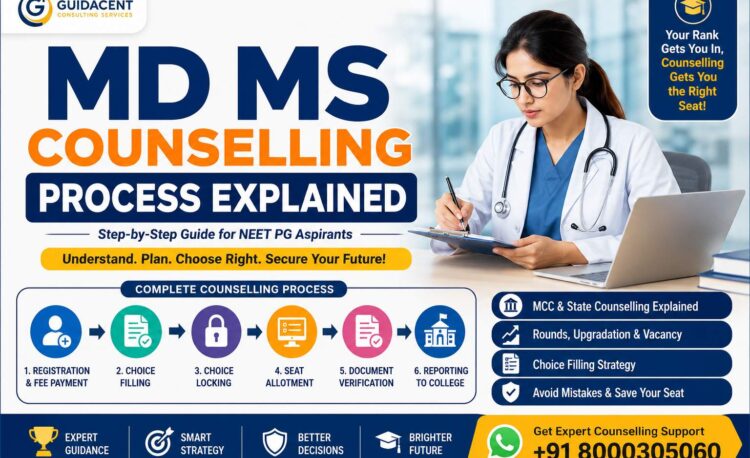
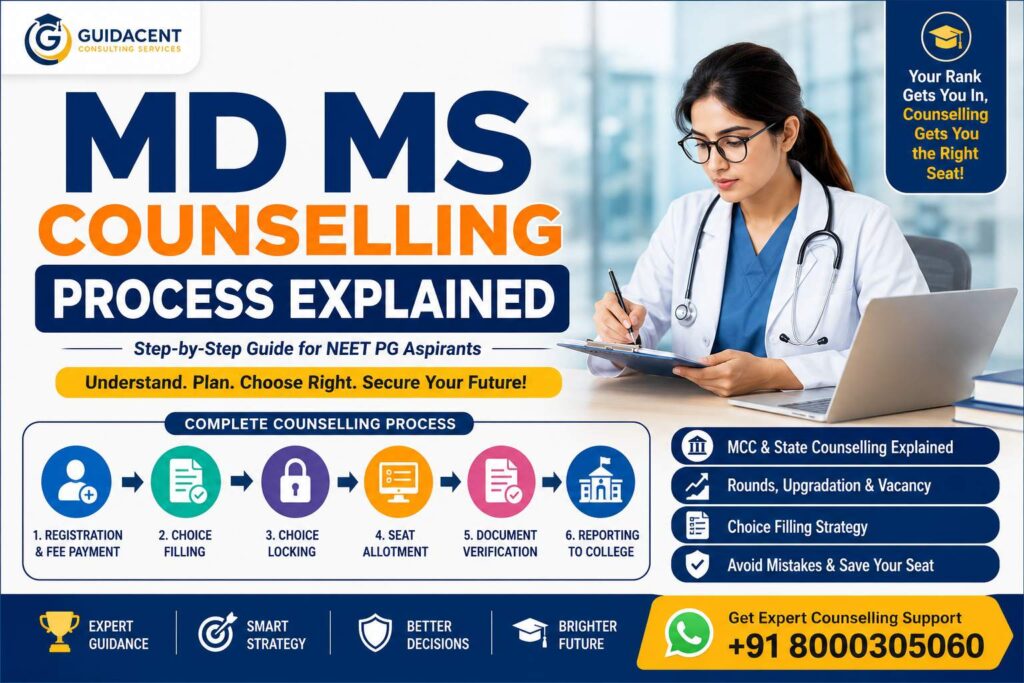
MD MS Counselling Process Explained: A Complete Step-by-Step Guide for NEET PG Aspirants
Understand registration, choice filling, seat allotment, upgradation, mop-up rounds, stray vacancy rules, documents, and counselling mistakes before locking your MD/MS preferences.
Before You Lock Your NEET PG Preferences
A single counselling mistake can affect years of preparation. Get clarity on choice filling, upgrade rules, round strategy, and seat movement before making a final decision.
Introduction: Why Brilliant Students Still Lose MD/MS Seats Every Year
Every year, thousands of MBBS graduates celebrate their NEET PG results. Yet surprisingly, many of those same students later lose seats they were actually eligible to secure. The reason? Not because of poor ranks. Not because of lack of effort. But because they misunderstood the counselling process. I have personally spoken with students who scored well enough to secure excellent postgraduate medical seats but lost opportunities due to:
- Incorrect choice filling
- Missing deadlines
- Poor counselling strategy
- Confusion between MCC and state counselling
- Wrong assumptions about seat allotment rules
- Failure to understand upgradation options
Most aspirants spend months preparing for NEET PG. However, very few spend sufficient time understanding how counselling actually works. Unfortunately, counselling is where admissions are finalized. A great rank without a proper counselling strategy can produce disappointing outcomes. On the other hand, a student with a moderate rank often secures a surprisingly good seat through smart planning. That is exactly why this guide exists. This article focuses specifically on the MD MS Counselling Process Explained, helping students understand how postgraduate medical counselling works in India and how to avoid the mistakes that repeatedly cost aspirants valuable opportunities. If you are looking for the broader postgraduate admission roadmap, you should also review this complete MD MS Admission in India guide.
Quick Answer: What Is the MD MS Counselling Process?
The MD MS counselling process is the official seat allocation system through which NEET PG qualified candidates secure postgraduate medical seats. Counselling involves registration, fee payment, choice filling, seat allotment, document verification, reporting, and upgradation rounds conducted by the Medical Counselling Committee and state authorities. Understanding the process is essential because counselling decisions ultimately determine admission outcomes.
What Is MD MS Counselling?
MD MS counselling is the centralized process used to allocate postgraduate medical seats to NEET PG qualified candidates. Instead of colleges directly selecting students, seats are allotted based on NEET PG rank, reservation policies, eligibility rules, and candidate preferences entered during counselling.
Many students imagine counselling as a simple seat selection process. In reality, it is a structured allocation system. Your rank matters. However, your preferences matter too. Your strategy matters. Your understanding of the rules matters. Counselling determines:
- Which college you receive
- Which specialty you receive
- Whether you receive an upgrade
- Whether you remain eligible for later rounds
This is why experienced advisors often say:
“NEET PG gets you into the game. Counselling determines how you finish.”
Students researching the broader MD MS Admission Process often discover that counselling decisions influence final outcomes just as much as examination performance.
Why Counselling Is More Important Than Most Students Realize
Many aspirants assume:
“My rank alone will decide everything.”
This belief creates serious problems. In reality, two candidates with similar ranks may achieve very different outcomes. One secures a preferred specialty. The other settles for a backup option.
Why?
Because counselling rewards preparation.
The counselling process is important because seat allotment depends not only on rank but also on choice filling, category eligibility, counselling participation, reporting decisions, and upgrade strategy. Students who understand these factors often secure better outcomes than those who focus only on rank.
Consider this common scenario. Student A has a stronger rank. Student B has a slightly weaker rank. However:
- Student B participates in every counselling round.
- Student B fills choices strategically.
- Student B understands upgrade options.
- Student B avoids common mistakes.
The result? Student B sometimes secures a more desirable seat. This happens every year.
Who Conducts MD MS Counselling in India?
Understanding the counselling authorities is one of the most important foundations of postgraduate medical admissions.
MD MS counselling in India is conducted by the Medical Counselling Committee (MCC) for All India Quota, deemed universities, central universities, and certain institutional seats. State counselling authorities conduct admissions for state quota seats in government and private medical colleges within their respective states.
Several organizations play key roles.
National Testing Agency (NTA)
Responsible for conducting NEET examinations in various contexts and facilitating examination processes.
National Medical Commission
The regulatory authority overseeing medical education standards in India.
Medical Counselling Committee (MCC)
Responsible for:
- All India Quota seats
- Deemed universities
- Central universities
- Certain institutional seats
State Counselling Authorities
Responsible for:
- State quota seats
- Private medical colleges
- State-specific admission processes
Students often confuse these authorities. Understanding their distinct roles reduces confusion during counselling.
MCC vs State Counselling Explained
This is perhaps the most misunderstood area of postgraduate medical admissions. Many students believe they must choose either MCC or state counselling. That assumption is incorrect.
MCC counselling and state counselling operate simultaneously but cover different seat pools. Eligible candidates can participate in both processes to maximize opportunities. Participating in one does not automatically prevent participation in the other, provided rules are followed correctly.
MCC Counselling Covers
- All India Quota seats
- Deemed university seats
- Central university seats
- Certain institutional seats
State Counselling Covers
- State quota government seats
- State private medical college seats
- Institutional quota seats under state regulations
Because the seat pools differ, many candidates participate in both systems. This increases opportunities significantly. Students exploring the MD MS Counselling Guide frequently discover that limiting themselves to a single counselling authority unnecessarily reduces options.
MD MS Counselling Process Explained Step-by-Step
Now let’s examine the actual process. Understanding these stages helps eliminate confusion and improve decision-making.
Step 1: Registration
Registration is the first formal stage of counselling. Candidates must create an account, submit required details, pay applicable counselling fees, and complete verification requirements before participating in seat allocation rounds.
Many students underestimate registration. However, small mistakes during registration can create significant complications later. During registration, candidates generally provide:
- Personal information
- Academic details
- NEET PG credentials
- Category information
- Communication details
Always verify entries carefully. Errors can delay later stages.
Step 2: Fee Payment
After registration, candidates pay counselling fees. Different counselling authorities may have different fee structures. Fee payment typically confirms participation. Many students wait until the final day. This creates unnecessary risk. Technical issues become far more stressful when deadlines approach.
Step 3: Choice Filling
This is where counselling becomes strategic. And unfortunately, this is where many students make serious mistakes.
Choice filling is the process of ranking preferred colleges and specialties. Seat allotment depends heavily on these preferences. A poorly constructed choice list can reduce opportunities even when a candidate has a competitive NEET PG rank.
Many aspirants approach choice filling emotionally. Instead, it should be approached systematically. A strong preference list balances:
- Dream choices
- Realistic choices
- Safe choices
Students should avoid:
- Extremely short preference lists
- Random ordering
- Following friends’ lists
- Copying social media recommendations
The best list reflects personal goals rather than public opinion.
Step 4: Choice Locking
After entering preferences, candidates usually lock their choices. Once locked, modifications may not be possible. Therefore: Review carefully. Double-check everything. Confirm specialty order. Confirm college order. Verify category details. A few minutes of review can prevent major regrets later.
Students Also Ask: How Many Choices Should I Fill?
Candidates should generally fill as many genuinely acceptable choices as possible. Restricting options unnecessarily can reduce seat allocation opportunities. However, students should avoid adding colleges or specialties they would never realistically accept.
The goal is not to fill the maximum number possible. The goal is to fill every option you would genuinely consider joining. That distinction matters.
Step 5: Seat Allotment
Once registration and choice filling are completed, seat allotment begins. This stage combines:
- Rank
- Category
- Seat availability
- Reservation policies
- Candidate preferences
Seat allotment is not random. It follows structured rules.
Seat allotment occurs when counselling authorities match candidate ranks with available seats and declared preferences. Candidates are allotted the highest available option according to counselling rules and seat availability.
Students sometimes feel disappointed when they do not receive their top choice. However, many later obtain upgrades through subsequent rounds. That is why understanding later stages becomes essential.
Why Students Lose Seats During Counselling
Several patterns repeat every year. Common reasons include:
Missing Registration Deadlines
An avoidable mistake that still affects many candidates.
Poor Choice Filling
Often caused by inadequate planning.
Ignoring Later Rounds
Many students assume opportunities end after Round 1. This is rarely true.
Following Unverified Advice
Social media groups frequently spread inaccurate information.
Emotional Decision-Making
Counselling should be guided by facts rather than panic.
Most counselling failures occur because students misunderstand rules, ignore deadlines, fill poor preference lists, or fail to participate strategically in later rounds. Careful planning often prevents these mistakes.
What Smart Students Do Differently
Experienced candidates tend to:
- Study counselling rules carefully
- Track deadlines consistently
- Participate in multiple rounds
- Fill comprehensive preference lists
- Understand upgrade opportunities
- Seek expert guidance when necessary
- Focus on long-term career goals rather than temporary trends
These habits often produce significantly better outcomes.
The next stage of counselling is where the biggest opportunities and the biggest mistakes occur. Choice filling, upgrades, Round 2 decisions, mop-up rounds, stray vacancies, and reporting rules can dramatically influence final outcomes. Many students who understand registration still struggle later because they do not understand these advanced counselling mechanics.
Choice Filling Strategy: The Most Underrated Skill in NEET PG Counselling
If NEET PG determines your eligibility, choice filling often determines your final outcome. Many students spend months preparing for the examination. Then they spend less than an hour preparing their preference list. That imbalance creates problems. Every year, candidates lose opportunities because they:
- Fill too few choices
- Copy someone else’s preference list
- Follow social media trends
- Ignore realistic options
- Focus only on college names
A successful counselling strategy requires much more than that.
Choice filling should balance dream options, realistic options, and safe options. Students should rank colleges and specialties according to genuine preference rather than expected availability. The counselling system automatically allocates the highest available choice based on rank and seat availability.
Think about preference filling as building a ladder. The top contains dream choices. The middle contains realistic possibilities. The bottom contains backup options you would genuinely accept. Many students create only dream choices. Others create only safe choices. Both approaches reduce opportunities. Students reviewing the broader MD MS Counselling Guide often discover that a balanced preference list produces significantly better outcomes. For complete postgraduate counselling planning, refer to the detailed MD MS Admission Process resource:
This question appears in almost every counselling season. The answer depends on your goals. However, most candidates benefit from filling a large number of acceptable choices.
Candidates should fill every college and specialty combination they would genuinely consider joining. Restricting options unnecessarily reduces seat allocation opportunities. However, candidates should never include branches or colleges they would absolutely refuse to join.
A useful rule: If you are unwilling to join it under any circumstances, do not include it. If you would realistically consider it, include it. This simple principle prevents many future regrets.
Understanding Seat Upgradation
One of the most misunderstood aspects of counselling is upgradation. Many students fear accepting a seat because they believe doing so prevents future improvement. In many cases, that assumption is incorrect.
Seat upgradation allows candidates to participate in later counselling rounds while retaining eligibility for a better option. If a higher preferred seat becomes available according to counselling rules, the candidate may receive an upgraded allotment.
Upgradation exists because seat movement continues throughout counselling. Students withdraw. Students upgrade. Vacancies emerge. As a result, opportunities often improve in later rounds. This is why experienced candidates carefully evaluate upgrade rules before making decisions.
Round 1 Counselling: What Most Students Get Wrong
Round 1 creates more anxiety than any other stage. Students often believe:
“If I don’t get my dream branch in Round 1, my chances are over.”
This is rarely true.
Round 1 is only the beginning of the counselling process. Many seats change hands during later rounds because candidates upgrade, withdraw, or shift to different institutions. Students should remain engaged throughout the counselling cycle.
Every year:
- Seats move
- Cutoffs shift
- Vacancies appear
- Better opportunities emerge
Therefore, Round 1 should be viewed as the start of the process rather than the final outcome.
Round 2 Counselling: Where Strategy Matters Most
For many candidates, Round 2 becomes the most important phase. By this stage:
- Vacancy patterns become clearer
- Candidate behavior becomes visible
- Cutoff trends become easier to analyze
This allows more informed decision-making.
Round 2 often presents opportunities that were unavailable during Round 1 because of seat movement, withdrawals, and upgrades. Students who remain flexible and informed frequently improve their outcomes during this stage.
Many aspirants stop paying attention after Round 1. That mistake costs seats every year. Successful candidates stay active throughout the entire counselling process.
Why Cutoffs Change Between Rounds
Students frequently ask:
“Why did a lower-ranked candidate get a seat in a later round?”
The answer lies in seat movement.
Several factors influence cutoff shifts:
Candidate Upgradation
Students move to better options.
Seat Surrender
Some candidates leave allotted seats.
Vacancy Creation
Unfilled positions become available.
Category-Based Movement
Different categories experience different vacancy patterns.
Counselling cutoffs change because seats continuously move between rounds. Candidate withdrawals, upgrades, category conversions, and vacancy creation all influence seat availability and closing ranks.
This is why counselling should never be viewed as a single-event process. It is a dynamic system.
Mop-Up Round Explained
The Mop-Up Round is often surrounded by confusion. Many students either misunderstand it or ignore it completely. Both are mistakes.
The Mop-Up Round is conducted after regular counselling rounds to fill remaining vacant seats. It provides additional opportunities for eligible candidates who have not secured satisfactory allotments during earlier stages.
By the time the Mop-Up Round begins:
- Several vacancies may remain
- Some candidates may have withdrawn
- Some institutions may still have unfilled seats
This creates fresh opportunities. Students who stay engaged until the end often benefit.
Stray Vacancy Round Explained
Among all counselling stages, the Stray Vacancy Round generates the most curiosity.
The Stray Vacancy Round is generally conducted to fill seats that remain vacant even after Mop-Up counselling. Eligibility rules vary, and candidates should carefully review official notifications before participating.
Many students mistakenly assume:
“No good seats remain.”
Reality often proves otherwise. Every year, candidates secure excellent opportunities during later stages because they remain attentive when others stop participating.
Common Counselling Mistakes That Cost Students Seats
Understanding mistakes can be just as important as understanding rules. Let’s examine the errors that repeatedly affect candidates.
Mistake #1: Following Social Media Rumors
Every counselling season produces endless speculation. Students hear:
- “This branch is finished.”
- “That college won’t move.”
- “No seats will remain.”
Much of this information lacks reliable verification. Always prioritize official notifications and structured counselling guidance.
Mistake #2: Filling Too Few Choices
Many aspirants dramatically restrict their options. As a result, they reduce seat allocation possibilities. A wider but carefully planned preference list often performs better.
Mistake #3: Ignoring State Counselling
Some candidates focus exclusively on MCC counselling. Others focus exclusively on state counselling. This unnecessarily limits opportunities. Students researching the complete MD MS Admission in India landscape typically participate wherever they are eligible.
Mistake #4: Missing Deadlines
One missed deadline can eliminate an entire counselling round. Every year this happens. Set reminders. Track schedules. Monitor notifications regularly.
Mistake #5: Emotional Decision Making
Panic is the enemy of smart counselling. Students sometimes:
- Withdraw too early
- Reject reasonable options
- Ignore future rounds
- Make rushed decisions
Counselling rewards patience and planning.
Most counselling mistakes result from poor planning rather than poor ranks. Missing deadlines, incomplete choice filling, emotional decisions, and failure to understand upgrade rules are among the most common reasons students lose opportunities.
Documents Required During MD/MS Counselling
Document preparation is another area many students underestimate. Missing paperwork can create unnecessary complications.
Commonly Required Documents
- NEET PG Score Card
- Admit Card
- MBBS Degree Certificate
- Internship Completion Certificate
- Permanent Registration Certificate
- Identity Proof
- Category Certificate (if applicable)
- Passport Size Photographs
- Allotment Letter
- Additional documents specified by counselling authorities
Candidates should verify document requirements directly from the official counselling authority because requirements can change. Preparing documents early helps avoid last-minute stress and reporting delays.
How Smart Candidates Plan Their Counselling Journey
After observing hundreds of counselling cycles, several habits consistently appear among successful candidates.
They Research Early
They start understanding counselling rules before results are announced.
They Create Multiple Preference Scenarios
They prepare:
- Optimistic plans
- Realistic plans
- Backup plans
They Track Every Round
They remain active throughout the counselling cycle.
They Stay Flexible
They adapt as vacancies and opportunities change.
They Seek Reliable Guidance
They rely on structured information rather than rumors.
Why Choose Guidacent Consulting Services?
Choosing preferences can feel overwhelming. Every counselling season brings:
- New rules
- Multiple rounds
- Conflicting advice
- Complex decisions
We help students navigate these challenges through structured counselling guidance.
- Choice filling strategy
- Specialty selection guidance
- Counselling planning
- College comparison
- Seat movement analysis
- Long-term career planning
- Preference list optimization
Before You Lock Your Preferences, Make Sure You Understand the Rules
A single counselling mistake can affect years of hard work. Don’t rely solely on rumors, social media groups, or incomplete information. Understand:
- Choice filling strategy
- Upgrade opportunities
- Round participation rules
- Seat movement patterns
- Long-term specialty planning
📞 Speak with an expert: +91 8000305060 📲 WhatsApp now: +91 8000305060
Student Counselling Experiences:
Student Testimonials
“I almost skipped Round 2. That round finally gave me the specialty I wanted.”
Dr. Arvind, Bangalore“My biggest mistake was filling too few choices. Better planning changed my result.”
Dr. Neha, Delhi“I learned that counselling strategy matters almost as much as rank.”
Dr. Sandeep, Hyderabad“Understanding upgradation rules completely changed my counselling approach.”
Dr. Akash, Chennai“Patience during counselling proved far more valuable than panic.”
Dr. Karan, Lucknow“The best advice I received was to remain active through every round.”
Dr. Vishal, Mysore“I almost skipped Round 2. That round finally gave me the specialty I wanted.”
Dr. Arvind, Bangalore“My biggest mistake was filling too few choices. Better planning changed my result.”
Dr. Neha, Delhi“Tracking vacancies carefully helped me make smarter decisions.”
Dr. Amit, Surat“I prepared documents early and avoided last-minute stress.”
Dr. Shreya, Kolkata“Understanding seat movement helped me stay optimistic.”
Dr. Harsh, MumbaiDon’t Let Counselling Mistakes Cost You a Seat
Every year students lose opportunities because they misunderstand:
- Upgradation rules
- Round participation
- Choice filling strategy
- Seat movement
Before finalizing your preferences, understand the complete counselling roadmap. 📲 WhatsApp: +91 8000305060 📞 Call: +91 8000305060
Frequently Asked Questions
FAQ 1: What Is the MD MS Counselling Process?
The MD MS counselling process is the official seat allocation mechanism through which NEET PG qualified candidates secure postgraduate medical seats. It includes registration, fee payment, choice filling, seat allotment, document verification, reporting, and multiple counselling rounds conducted by MCC and state authorities.
FAQ 2: Who Conducts MD MS Counselling in India?
The counselling process is conducted by:
- Medical Counselling Committee (MCC)
- State Counselling Authorities
MCC manages:
- All India Quota seats
- Deemed Universities
- Central Universities
State authorities manage:
- State quota seats
- Private medical colleges
- State-specific institutions
FAQ 3: Can I Participate in Both MCC and State Counselling?
Yes. Most eligible candidates can participate in both MCC and state counselling simultaneously. Since both processes cover different seat pools, participation often increases opportunities.
FAQ 4: Is Registration Mandatory for Every Counselling Round?
Generally, candidates must follow the registration requirements specified by the counselling authority. Always verify the latest official notification because rules can change.
FAQ 5: How Important Is Choice Filling?
Choice filling is one of the most important parts of counselling. Even students with excellent NEET PG ranks can lose opportunities because of poor preference planning.
FAQ 6: How Does Seat Allotment Work?
Seat allotment occurs when counselling software matches candidate rank, category, seat availability, and preference order. The system allocates the highest available choice according to counselling rules.
FAQ 7: What Is Seat Upgradation?
Seat upgradation allows eligible candidates to receive a better preference during later rounds if vacancies become available.
FAQ 8: Can I Get a Better Seat in Round 2?
Yes. Every year candidates receive better seats during Round 2 because:
- Vacancies emerge
- Students upgrade
- Some candidates withdraw
FAQ 9: What Is the Mop-Up Round?
The Mop-Up Round is conducted to fill remaining vacant seats after the main counselling rounds.
FAQ 10: What Is the Stray Vacancy Round?
The Stray Vacancy Round fills seats that remain vacant after all previous counselling stages. Eligibility rules vary and candidates should review official counselling notifications carefully.
FAQ 11: What Documents Are Required During Counselling?
Common documents include:
- NEET PG Scorecard
- Admit Card
- MBBS Degree
- Internship Completion Certificate
- Medical Registration Certificate
- Identity Proof
- Category Certificate (if applicable)
FAQ 12: Can I Participate in Later Rounds If I Don’t Get a Seat Initially?
In many cases, yes. Counselling opportunities often continue through multiple rounds. Candidates should understand the applicable rules before making decisions.
FAQ 13: Why Do Counselling Cutoffs Change?
Cutoffs change because:
- Students upgrade
- Seats become vacant
- Category conversions occur
- Additional vacancies emerge
FAQ 14: Can Lower Ranked Candidates Sometimes Get Better Seats?
Yes. Counselling strategy can influence outcomes. Students who understand choice filling and round participation often maximize opportunities.
FAQ 15: What Is the Biggest Counselling Mistake?
The biggest mistake is assuming counselling is simple. Many candidates underestimate:
- Preference planning
- Deadlines
- Seat movement
- Upgrade rules
FAQ 16: Is Counselling More Important Than Rank?
Rank determines eligibility and available options. Counselling determines how effectively those options are utilized. Both are important for securing a desirable postgraduate medical seat.
FAQ 17: Should I Take Expert Counselling Guidance?
Students with complex situations, category considerations, multiple counselling opportunities, or specialty confusion often benefit from professional counselling guidance.
Voice Search Optimization Section
These questions are designed to improve visibility in:
- Google Voice Search
- Google Assistant
- AI Overviews
- ChatGPT Search
- Gemini
- Perplexity
After NEET PG results, candidates register for counselling, fill preferences, participate in seat allotment rounds, complete document verification, and report to allotted institutions according to counselling rules.
Yes. Eligible candidates usually participate in both counselling systems because they cover different seat pools.
Counselling generally includes:
- Round 1
- Round 2
- Mop-Up Round
- Stray Vacancy Round
Specific structures may vary.
Opportunities for upgrades may exist during later rounds according to counselling rules.
Final Expert Conclusion
The counselling process is where postgraduate medical admissions are ultimately decided. Many students focus entirely on their NEET PG score. However, counselling is where opportunities are gained—or lost. The difference between securing a preferred specialty and settling for an unwanted option often comes down to:
- Preparation
- Strategy
- Patience
- Understanding the rules
Successful candidates do not simply participate in counselling. They understand it. They plan for it. They remain engaged throughout every stage. Most importantly, they avoid emotional decisions. The smartest approach is not merely chasing a seat. The smartest approach is securing the right seat. That distinction shapes careers. Students who understand the MD MS Counselling Process Explained framework place themselves in a stronger position to make informed decisions throughout postgraduate medical admissions. For complete postgraduate admission guidance, students should also review the comprehensive MD MS Admission in India pillar resource:
https://www.guidacentconsultingservices.com/md-ms-admission/
Need MD/MS Counselling Guidance?
Get support for preference list planning, college comparison, branch selection, seat movement analysis, and long-term postgraduate medical career planning.
Before making your final counselling choices, NEET PG Aspirants should also explore:
- Low NEET PG Rank MD MS Admission Options
- MD MS Admission Through Management Quota
- MD MS Admission Through NRI Quota
- NEET PG Counselling Mistakes Students Must Avoid
- MD MS Admission Fees in India
- How to Get MD MS Admission in India
- Direct MD MS Admission in India
- What is MD MS Admission?
- Deemed Universities for MD MS Admission
- Is NEET PG Mandatory for MD MS?
- Can I Get MD MS With Low Rank?
- MD vs MS: Which Is Better?
Written by
Sunny Yadav
Founder – Guidacent Consulting Services Pvt. Ltd.
12+ years experience in Engineering | Medical | Management | Admission Guidance in Top colleges of India & Abroad