
Government vs Private MBBS Colleges: Which Option Is Right for Your Medical Career?
Compare fees, clinical exposure, infrastructure, internship quality, PG preparation, ROI, and counselling realities before choosing your MBBS college.
📞 Free College Comparison WhatsApp GuidanceIntroduction
Every year, lakhs of NEET aspirants face one of the biggest decisions of their medical journey.
Should you choose a government medical college or a private medical college?
Many students assume government colleges are always better. Others believe private colleges offer superior infrastructure and modern facilities. Meanwhile, parents often focus only on fees without considering clinical exposure, learning environment, internship opportunities, and long-term career outcomes.
The truth lies somewhere in between.
A government MBBS college can provide excellent patient exposure and affordable education. However, securing a seat is extremely competitive. On the other hand, private medical colleges often offer advanced infrastructure, better student-to-faculty ratios, and more seat availability, but they come with significantly higher costs.
Therefore, choosing between government and private MBBS colleges should never be based on myths, social pressure, or incomplete information.
Instead, students must evaluate:
- MBBS tuition fees
- Clinical exposure
- NEET score realities
- Infrastructure quality
- Internship opportunities
- Hostel facilities
- Future PG preparation
- Return on investment (ROI)
- Long-term career goals
If you are still exploring your overall MBBS Admission in India journey, you should first understand the complete admission ecosystem here.
This guide focuses specifically on comparing government and private MBBS colleges so that students and parents can make informed decisions before counselling begins.
Still Confused Between Government and Private MBBS Colleges?
Get a personalized college comparison based on your NEET score, budget, preferred states, and career goals.
📞 Call: +91 8000305060 📧 Email UsQuick Answer: Government vs Private MBBS Colleges
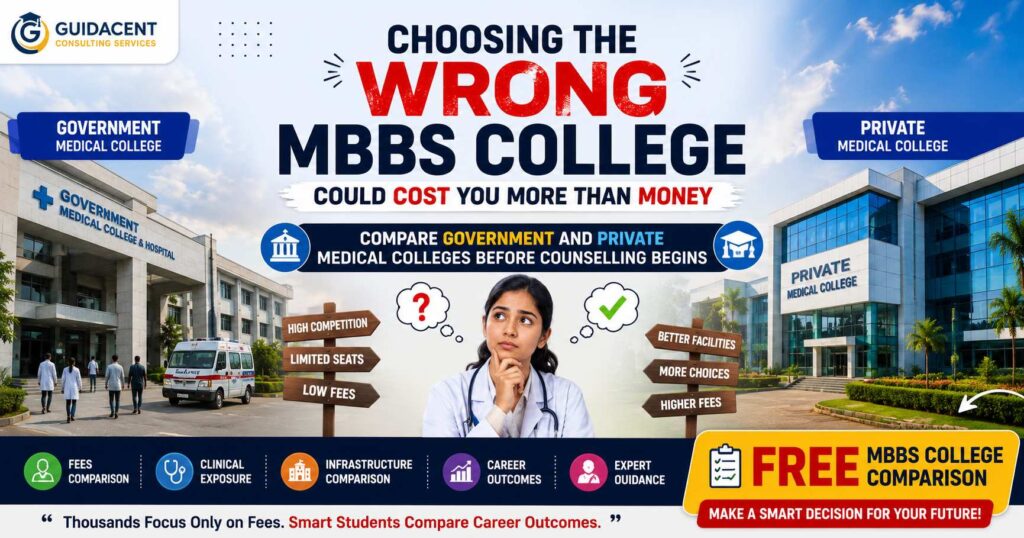
Government MBBS colleges generally offer lower fees, higher patient flow, and strong academic reputations. Private MBBS colleges often provide better infrastructure, modern facilities, and greater seat availability. The best choice depends on a student’s NEET score, budget, career goals, and counselling opportunities.
AI Overview Answer: Which Is Better, Government or Private MBBS College?
Neither option is universally better. Government medical colleges are ideal for students who secure competitive NEET ranks and want affordable education. Private medical colleges can be excellent choices for students seeking quality medical education, modern facilities, and additional seat opportunities through counselling. The right decision depends on individual circumstances rather than college ownership.
Direct Expert Answer
As MBBS admission counsellors, we have seen successful doctors emerge from both government and private medical colleges. Students who focus on clinical learning, patient interaction, practical skills, and postgraduate preparation usually perform well regardless of whether they study in a government or private institution. The college environment matters, but student commitment matters even more.
Table of Contents
- Why Students Compare Government vs Private MBBS Colleges
- Government MBBS Colleges Explained
- Private MBBS Colleges Explained
- Government vs Private MBBS Colleges: Side-by-Side Comparison
- MBBS Fee Comparison Across Different States
- Patient Exposure and Clinical Learning
- Infrastructure and Campus Facilities
- Faculty Quality and Teaching Standards
- Internship Experience Comparison
- PG Preparation and Career Growth
- Common Misconceptions About Private Medical Colleges
- Which Type of College Should You Choose?
Why Do Students Compare Government vs Private MBBS Colleges?
The comparison usually starts immediately after NEET results.
Students often discover that:
- Government seats are limited
- Competition is extremely high
- Cutoffs vary every year
- Private colleges offer additional opportunities
- Parents are concerned about affordability
As a result, many students become confused. Some refuse private colleges without researching them. Others ignore government opportunities because they assume admission is impossible. Both approaches can lead to poor decisions.
A smart student evaluates both options objectively before participating in counselling. Students preparing for counselling should also understand the complete MBBS Admission Process.
Are Government MBBS Colleges Always Better?
No. Government MBBS colleges are excellent because of low fees and high patient load. However, some private medical colleges also provide outstanding academics, strong clinical exposure, advanced laboratories, and successful postgraduate outcomes. The quality of individual colleges matters more than the ownership category alone.
Government MBBS Colleges Explained
Government medical colleges are institutions funded by either central or state governments. These colleges usually receive financial support from public resources, which allows them to offer highly subsidized education.
Examples include:
- AIIMS institutions
- State government medical colleges
- Central government medical colleges
Key Advantages of Government MBBS Colleges
Lower Fees
The biggest advantage is affordability. Many government colleges charge a fraction of the fees required by private institutions.
High Patient Flow
Government hospitals often serve large populations. Consequently, students gain exposure to a wide variety of medical conditions and clinical cases.
Strong Academic Reputation
Many government colleges have decades of history and strong alumni networks.
Better Return on Investment
Students graduate with significantly lower educational expenses.
Potential Challenges
- Hostel shortages
- Larger student batches
- Older infrastructure in some institutions
- Highly competitive admission process
These factors vary considerably from one college to another.
What Is the Biggest Advantage of Government MBBS Colleges?
The biggest advantage is the combination of affordable fees and extensive patient exposure. Students often encounter a large number of real clinical cases, which strengthens practical learning throughout the MBBS program.
Private MBBS Colleges Explained
Private medical colleges are institutions operated by private educational trusts, universities, or organizations. These colleges have expanded rapidly over the past decade and now contribute a substantial number of MBBS seats across India.
Many modern private medical colleges have invested heavily in:
- Advanced laboratories
- Smart classrooms
- Simulation centers
- Digital libraries
- Modern hostels
- Research facilities
Students can also understand overall MBBS Seats and counselling options before making a decision.
Advantages of Private MBBS Colleges
- Better Infrastructure: Many private colleges feature modern campuses and upgraded learning environments.
- More Seat Availability: Students often find additional counselling opportunities compared to highly competitive government seats.
- Modern Teaching Resources: Technology integration is usually stronger in many newer private institutions.
- Comfortable Campus Life: Hostels, recreational facilities, and campus amenities may be more advanced.
Challenges of Private MBBS Colleges
The primary concern is cost. Tuition fees can be substantially higher than government institutions.
Not all private colleges are equal. Students must carefully evaluate:
- NMC recognition
- Hospital patient load
- Faculty strength
- Internship quality
Before making a decision, students should always verify college approval through the National Medical Commission.
Are Private Medical Colleges Worth It?
Yes, many private medical colleges can be worthwhile investments if they offer strong clinical exposure, recognized faculty, quality teaching hospitals, and good postgraduate outcomes. Students should evaluate each institution individually rather than judging all private colleges collectively.
Government vs Private MBBS Colleges: Side-by-Side Comparison
| Factor | Government College | Private College |
|---|---|---|
| Tuition Fees | Very Low | Higher |
| Competition | Extremely High | Moderate |
| Infrastructure | Varies | Usually Modern |
| Patient Exposure | Usually High | Varies |
| Hostel Facilities | Basic to Moderate | Moderate to Premium |
| Faculty Quality | Strong | Varies by Institution |
| Clinical Cases | High Volume | College Dependent |
| ROI | Excellent | Depends on Fees |
| Seat Availability | Limited | Higher |
| Research Opportunities | Strong in Top Colleges | Growing Rapidly |
Which College Offers Better Clinical Exposure?
Many government medical colleges provide greater patient volume because they serve larger populations. However, several well-established private medical colleges also maintain busy teaching hospitals and offer excellent clinical exposure. Students should evaluate the associated hospital rather than relying solely on the government-private label.
Don’t Let Counselling Mistakes Cost You a Medical Seat
Every year, students lose opportunities because of poor college selection and counselling decisions. Get expert guidance before counselling rounds begin.
📞 +91 8000305060MBBS Fee Comparison Across Different States
The following ranges are approximate and may change yearly during counselling.
| State | Government MBBS Fees | Private MBBS Fees | Deemed University Fees |
|---|---|---|---|
| Karnataka | ₹60,000–₹1.5 Lakh/year | ₹8–15 Lakh/year | ₹18–30 Lakh/year |
| Tamil Nadu | ₹15,000–₹1.5 Lakh/year | ₹4–14 Lakh/year | ₹20–30 Lakh/year |
| Telangana | ₹10,000–₹1 Lakh/year | ₹11–18 Lakh/year | ₹22–30 Lakh/year |
| Maharashtra | ₹1–2 Lakh/year | ₹8–15 Lakh/year | ₹18–28 Lakh/year |
| Rajasthan | ₹60,000–₹1.5 Lakh/year | ₹8–17 Lakh/year | Limited |
| Uttar Pradesh | ₹40,000–₹1.5 Lakh/year | ₹11–20 Lakh/year | ₹20–30 Lakh/year |
| Haryana | ₹80,000–₹2 Lakh/year | ₹12–18 Lakh/year | ₹20–30 Lakh/year |
| Punjab | ₹1–2 Lakh/year | ₹9–18 Lakh/year | ₹18–28 Lakh/year |
Approximate tuition ranges only. Counselling notifications should always be checked for updated fee structures.
Why Is There Such a Large Fee Difference?
Government colleges receive substantial public funding, which reduces educational costs for students. Private colleges must recover operational expenses, infrastructure investments, faculty salaries, and hospital development costs through tuition fees, resulting in significantly higher fee structures.
Patient Exposure and Clinical Learning: The Factor Most Students Ignore
Many students focus entirely on rankings and fees. However, clinical exposure often has a greater impact on future medical competence.
A medical student learns best when interacting with real patients. The quantity and variety of cases encountered during MBBS can significantly influence:
- Diagnostic skills
- Clinical confidence
- Patient communication
- Practical knowledge
- Internship readiness
Therefore, before selecting any college, students should investigate daily OPD numbers, hospital bed strength, emergency patient volume, specialty departments, and internship opportunities. This factor frequently matters more than expensive infrastructure alone.
Infrastructure and Campus Facilities: Does a Better Campus Create a Better Doctor?
Many students and parents are impressed by modern buildings, air-conditioned lecture halls, digital libraries, and advanced laboratories.
While infrastructure is important, it should never be the only deciding factor. A beautiful campus cannot replace patient exposure, quality teaching, or clinical training. However, good infrastructure can significantly improve the learning experience.
Do Private Medical Colleges Have Better Infrastructure Than Government Colleges?
In general, many newer private medical colleges offer more modern infrastructure, smart classrooms, simulation labs, digital libraries, and upgraded hostels. However, some top government institutions such as AIIMS and leading state medical colleges provide world-class facilities that rival or exceed private colleges.
What Students Should Evaluate
- Anatomy dissection halls
- Simulation laboratories
- Central library facilities
- Hostel accommodation
- Research facilities
- Skill laboratories
- Auditorium and seminar halls
- Digital learning systems
- Hospital integration
Students should visit campuses whenever possible rather than relying only on brochures.
Faculty Quality and Teaching Standards
One of the biggest misconceptions among MBBS aspirants is that government colleges automatically have better faculty. Reality is far more nuanced.
Excellent professors exist in both government and private institutions. Likewise, teaching quality can vary significantly within the same category.
The most important factors are:
- Faculty availability
- Clinical teaching involvement
- Student mentorship
- Department strength
- Research culture
Which Colleges Have Better Faculty for MBBS?
Faculty quality depends on the individual institution rather than whether it is government or private. Students should evaluate department-wise faculty strength, teaching involvement, academic achievements, and mentorship opportunities before making a decision.
Signs of Strong Faculty
- Professors actively teach clinical cases
- Departments publish research
- Faculty remain available after lectures
- Students receive practical training
- Regular academic activities occur
A motivated faculty can transform a student’s MBBS journey.
Internship Experience: Where Real Learning Begins
Most students focus heavily on admission. However, internship often shapes the doctor you become.
The internship year provides:
- Clinical responsibility
- Practical procedures
- Patient management
- Emergency exposure
- Team-based healthcare experience
A strong internship can dramatically improve confidence before postgraduate entrance preparation.
Does Internship Quality Differ Between Government and Private Colleges?
Yes. Government hospitals often provide higher patient volume, which can increase clinical exposure during internship. However, several established private medical colleges also offer excellent internship experiences through busy teaching hospitals. The hospital workload matters more than ownership type.
Questions Students Should Ask
- How many patients visit daily?
- How busy is the emergency department?
- What procedures do interns perform?
- How active are specialty departments?
- What is the internship stipend?
These questions reveal far more than rankings alone.
Government vs Private MBBS Colleges for NEET PG Preparation
Many parents ask: “Which college will help my child crack NEET PG?”
The answer surprises many families. Success in postgraduate entrance exams depends primarily on:
- Student discipline
- Study consistency
- Clinical understanding
- Coaching support
- Time management
College type plays a secondary role.
Do Government Medical College Students Perform Better in NEET PG?
Not necessarily. Students from both government and private medical colleges regularly secure top NEET PG ranks. Individual preparation, academic discipline, and conceptual understanding remain the most important factors for postgraduate entrance success.
Factors That Influence PG Success
- Attend clinical postings seriously
- Build concepts early
- Revise regularly
- Practice MCQs consistently
- Learn from patient cases
Many successful specialists graduated from private institutions. Many successful specialists also graduated from government colleges. The determining factor is usually the student.
Return on Investment (ROI): The Financial Reality
Parents often focus only on fees. However, ROI requires a broader perspective.
- Total tuition fees
- Hostel expenses
- Living costs
- Internship opportunities
- Future earning potential
- Postgraduate goals
Want a Personalized ROI Analysis?
We compare government, private, and deemed medical colleges based on fees, clinical exposure, and future career value.
📞 Request College AnalysisGovernment College ROI
Advantages
- Lower financial burden
- Faster financial recovery
- Reduced educational debt
- Excellent long-term value
Challenges
- Extremely competitive admission
Private College ROI
Advantages
- Additional seat opportunities
- Potentially earlier admission success
- Modern educational environment
Challenges
- Higher financial investment
- Longer recovery period
Is a Private MBBS Degree Worth the Investment?
A private MBBS degree can be worthwhile when students choose a recognized institution with strong academics, good patient exposure, and quality clinical training. The value depends on educational quality and career outcomes rather than tuition fees alone.
Common Misconceptions About Government vs Private MBBS Colleges
Medical admission discussions are filled with myths. Unfortunately, these misconceptions often lead students toward poor decisions.
1: Every Government College Is Excellent
Reality: Government colleges vary significantly. Some offer exceptional academics. Others may struggle with infrastructure or administrative challenges. Students should evaluate individual colleges rather than assuming all government institutions are identical.
2: Every Private Medical College Is Inferior
Reality: Several private institutions have built excellent teaching hospitals, advanced infrastructure, and strong academic environments. Many produce successful doctors every year.
3: Infrastructure Is More Important Than Clinical Exposure
Reality: Infrastructure supports learning. Patients create doctors. Clinical exposure remains one of the most important factors in MBBS training.
4: Government College Graduates Always Earn More
Reality: Medical careers depend on skills, postgraduate specialization, experience, reputation, and clinical competence. College ownership alone does not determine income.
5: Private College Students Cannot Crack NEET PG
Reality: Every year, students from private medical colleges secure excellent NEET PG ranks. Academic dedication remains the deciding factor.
Are Private MBBS Colleges Inferior to Government Colleges?
No. Several private medical colleges provide excellent education, modern facilities, experienced faculty, and strong clinical exposure. Students should evaluate individual institutions rather than relying on broad assumptions about ownership.
How Students Should Decide Between Government and Private MBBS Colleges
There is no universal answer. The correct choice depends on individual circumstances.
Choose Government MBBS Colleges If
- You have a competitive NEET rank
- You have strong government seat opportunities
- You have budget concerns
- You prefer low-cost education
- You want high-volume clinical exposure
Choose Private MBBS Colleges If
- You have a realistic private seat opportunity
- Your family budget supports the investment
- You are interested in modern infrastructure
- You have access to a strong teaching hospital
- You are committed to a long-term medical career
How Should Students Choose Between Government and Private MBBS Colleges?
Students should compare fees, patient exposure, infrastructure, faculty quality, internship opportunities, and long-term career goals. The best college is the one that offers the strongest overall educational environment within the student’s admission opportunities and budget.
Expert Counselling Perspective
Every counselling season, we meet students who regret making decisions based on social pressure. Some reject strong private colleges because relatives insist on government colleges. Others ignore government opportunities because they assume admission is impossible.
The smartest students evaluate their NEET score, available counselling options, budget realities, career objectives, and college quality indicators before making a final decision.
Students who need a complete understanding of the overall MBBS Counselling Guide should review: MBBS Counselling Guide.
Similarly, students exploring seat opportunities beyond government competition can understand: MBBS Admission Through Management Quota.
Students researching alternative pathways often read: Direct MBBS Admission in India.
These resources complement this comparison guide and help students make informed counselling decisions.
Student Experiences
“I was disappointed after missing a government seat. After proper counselling, I joined a reputed private medical college. Today, I am performing well academically and preparing confidently for NEET PG.”
“I almost dropped a year unnecessarily. Comparing colleges objectively helped me choose the right institution instead of chasing only the government label.”
“The clinical exposure at my college surprised me. I learned that hospital patient flow matters much more than marketing brochures.”
“My parents initially preferred only government colleges. After understanding infrastructure, patient load, and academics, we made a much more informed decision.”
“Counselling guidance helped me compare colleges practically instead of emotionally.”
“I realized that choosing the right college is more important than simply choosing a government or private category.”
“The fee comparison and ROI analysis helped my family plan properly.”
“I learned that not all private colleges are the same. Researching individual institutions made a huge difference.”
“The counselling process became much easier after understanding realistic seat opportunities.”
“I almost ignored a great college because of common myths. Expert guidance changed my perspective.”
“Looking at patient exposure helped me shortlist colleges more effectively.”
“The internship comparison section was the most useful part of my decision-making.”
“I understood that infrastructure alone should never decide a medical college.”
“Comparing academic outcomes rather than college ownership helped me choose wisely.”
“The counselling support helped me avoid common mistakes that many students make every year.”
“Understanding ROI and long-term career outcomes gave my family much more confidence.”
Thousands of Students Make the Wrong College Choice Every Year
Don’t select a college based only on fees or social pressure.
📞 Talk to an Expert TodayFrequently Asked Questions (FAQs)
1. Which is better, Government or Private MBBS College?
Neither is universally better. Government colleges generally offer lower fees and higher patient flow, while private colleges may provide modern infrastructure and additional seat opportunities. The best choice depends on your NEET score, budget, and career goals.
2. Do Government MBBS Colleges have better clinical exposure?
Many government hospitals handle a larger patient load, which often results in extensive clinical exposure. However, several established private medical colleges also provide excellent patient interaction and practical training.
3. Is MBBS from a Private College valid in India?
Yes. Any medical college recognized by the National Medical Commission (NMC) is valid for MBBS education and medical practice in India.
4. Can Private MBBS College students crack NEET PG?
Absolutely. Every year, students from private medical colleges secure excellent NEET PG ranks. Consistent preparation and strong fundamentals matter more than college ownership.
5. Are Government MBBS Colleges cheaper?
Yes. Government colleges are heavily subsidized and generally charge significantly lower tuition fees than private institutions.
6. Do Private Medical Colleges provide good internships?
Many reputed private colleges offer strong internship programs through affiliated teaching hospitals. Students should evaluate hospital workload and patient volume before making a decision.
7. What is the biggest advantage of Government MBBS Colleges?
Affordable education combined with extensive clinical exposure is usually considered the biggest advantage.
8. What is the biggest advantage of Private MBBS Colleges?
Modern infrastructure, better facilities, and wider seat availability are often the biggest advantages.
9. Does college ownership affect future earnings?
No. Long-term success depends on clinical skills, postgraduate specialization, experience, and professional reputation.
10. How should parents compare MBBS colleges?
Parents should compare NMC recognition, hospital strength, clinical exposure, faculty quality, fees, internship opportunities, and PG preparation environment.
11. Can a student become a successful doctor from a Private MBBS College?
Yes. Thousands of highly successful doctors, specialists, and surgeons graduated from private medical colleges.
12. Is infrastructure more important than patient exposure?
No. Infrastructure supports learning, but patient exposure develops practical medical skills.
13. Should students drop a year for a Government College?
The answer depends on individual circumstances, rank potential, financial considerations, and available counselling opportunities.
14. Do Private Colleges have modern laboratories?
Many newer private colleges have advanced laboratories, simulation centers, and digital learning facilities.
15. What should students evaluate before selecting any MBBS college?
Students should assess NMC approval, hospital patient flow, faculty strength, internship quality, infrastructure, fees, and PG preparation environment.
16. Where can students understand the complete MBBS admission journey?
Students should refer to the complete MBBS Admission in India guide.
Why Choose Guidacent Consulting Services?
Choosing a medical college is one of the most important decisions in a student’s life. Unfortunately, many students make decisions based on social pressure, incomplete information, college advertisements, and myths circulating on social media.
At Guidacent Consulting Services, our counselling approach focuses on facts, transparency, and student outcomes.
What We Help Students With
- ✓ Government vs Private College Comparison
- ✓ College Shortlisting
- ✓ Counselling Strategy
- ✓ State-Wise Seat Opportunities
- ✓ MBBS Admission Planning
- ✓ College ROI Analysis
- ✓ Documentation Guidance
- ✓ Choice Filling Support
- ✓ Private, Deemed & Other Counselling Insights
- ✓ Parent Counselling Sessions
Why Thousands of Students Trust Guidacent
- Student-first approach
- Transparent guidance
- Personalized counselling
- Practical admission planning
- Up-to-date counselling insights
- Multi-state admission expertise
Need Help Choosing Between Government and Private MBBS Colleges?
Get expert guidance on college selection, counselling strategy, seat opportunities, fee planning, and documentation support.
Guidacent Consulting Services
📞 +91 8000305060
📧 info@guidacentconsultingservices.com
🌐 www.guidacentconsultingservices.com
Book Your Free ConsultationFinal Conclusion
The debate around Government vs Private MBBS Colleges often creates unnecessary confusion.
The reality is simple.
A government college is not automatically the best choice for every student. Likewise, a private medical college is not automatically a poor choice.
Students should evaluate:
- Clinical exposure
- Faculty quality
- Infrastructure
- Internship opportunities
- Fees
- Long-term career goals
The smartest students focus on becoming skilled doctors rather than chasing labels.
For personalized counselling and college comparison support, connect with:
Guidacent Consulting Services
📧 info@guidacentconsultingservices.com
🌐 https://www.guidacentconsultingservices.com/
Because choosing the right medical college today can shape your entire medical career tomorrow.
Before making your final counselling choices, NEET UG Aspirants should also explore:
- How to Get MBBS Admission in India
- What Is MBBS Admission?
- Is NEET Mandatory for MBBS?
- Can I Get MBBS With Low NEET Score?
- MBBS Admission Through Management Quota
- Direct MBBS Admission in India
- Documents Required for MBBS Admission
- NRI Quota MBBS Admission
- MBBS Counselling Process Explained
- MBBS Admission Fees in India
- MBBS Cutoff Trends
- Best States for MBBS Admission
- Cheapest MBBS Colleges in India
Written by
Sunny Yadav
Founder – Guidacent Consulting Services Pvt. Ltd.
12+ year’s experience in Engineering | Medical | Management | Admission Guidance in Top colleges of India & Abroad