
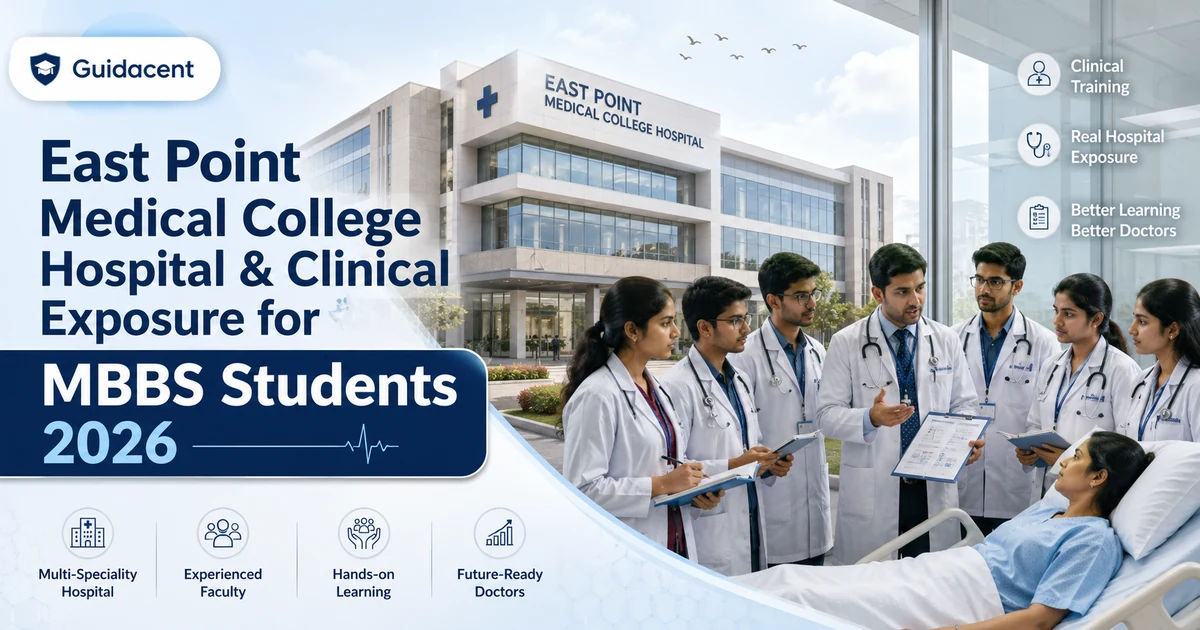
 Clinical rounds and hands-on bedside patient training at East Point Hospital, Bangalore.
East Point Medical College Hospital & Clinical Exposure for MBBS Students 2026
When selecting a medical college, NEET UG aspirants and their parents frequently scrutinise annual tuition fees, campus infrastructure, and cutoff ranks. However, the definitive measure of a doctor’s training quality is the teaching hospital. Without consistent patient footfall, diverse clinical pathologies, and regular bedside learning under seasoned consultants, an undergraduate medical education remains incomplete. For candidates shortlisting Karnataka state counselling options, evaluating real clinical training parameters is critical before finalising preference entries.
The teaching hospital attached to an institution dictates whether you spend your clinical posting years observing from a distance or actively developing diagnostic acumen under clinical heads. Below is an objective analysis of hospital infrastructure, outpatient flow, bed occupancy, and rotational clinical postings at East Point College of Medical Sciences & Research Centre (EPCMS), Bangalore.
Quick Answer: How Strong Is Clinical Exposure at East Point Medical College?
East Point Medical College delivers robust, hands-on clinical exposure supported by an on-campus teaching hospital with over 1,000 beds and an average daily outpatient department (OPD) footfall of 1,800 to 2,500 patients. Situated on the Old Madras Road corridor, its patient demographic spans rural, industrial trauma, and urban lifestyle pathologies, ensuring balanced diagnostic diversity.
Key Takeaways for 2026 MBBS Aspirants
- Hospital Capacity: Multi-speciality teaching facility housing 1,000+ sanctioned beds adhering strictly to National Medical Commission (NMC) operational standards.
- Geographic Catchment: Located in Avalahalli (East Bangalore), drawing patient inflows from rural Hoskote, industrial zones, and suburban eastern Bengaluru.
- CBME Integration: Rotational clinical postings structured sequentially under the NMC Competency-Based Medical Education curriculum, beginning in Phase II.
- Emergency & Intensive Care: Fully functional round-the-clock emergency casualty wings, multi-slice diagnostic radiology, and dedicated ICU, ICCU, NICU, and PICU facilities.
- Regulatory Route: All MBBS allotments are governed exclusively through Karnataka Examinations Authority (KEA) merit counselling following NEET UG qualification.
Understanding East Point Medical College Clinical Exposure 2026
To accurately evaluate east point medical college clinical exposure 2026, candidates must look beyond general brochures and examine the daily functioning of East Point Hospital. Founded in 2017 under the MG Charitable Trust, EPCMS is affiliated with Rajiv Gandhi University of Health Sciences (RGUHS) and recognised by the NMC. For a complete overview of seat matrices, fee structures, and document protocols, explore our comprehensive guide on MBBS admission in East Point Medical College.
Clinical pedagogy at EPCMS is rooted in direct, repetitive bedside interaction. Starting from the second professional year, undergraduate students rotate through clinical departments daily, participating in morning ward rounds, case history elicitation, and differential diagnosis discussions led by clinical professors.
Teaching Hospital Scale: Bed Strength and Departmental Allocation
Clinical learning is fundamentally constrained by active bed numbers and inpatient volume. East Point Hospital operates as a comprehensive tertiary care hospital, having expanded its operational bed count to over 1,000 beds. This scale supports academic bedside teaching requirements and community tertiary healthcare needs.
Wards are organised across primary and allied clinical specialities to satisfy NMC norms:
- General Medicine: Dedicated teaching units handling infectious conditions, non-communicable diseases, geriatric care, and metabolic disorders.
- General Surgery: Segregated male and female surgical wards managing elective abdominal cases, acute appendicitis, hernias, and surgical infections.
- Obstetrics & Gynaecology (OBG): High-volume antenatal, postnatal, and labour rooms serving expectant mothers from surrounding rural and suburban districts.
- Paediatrics & Neonatology: General paediatric units paired with high-dependency Neonatal Intensive Care (NICU) and Paediatric Intensive Care (PICU).
- Orthopaedics: Inpatient beds handling road traffic trauma, spine disorders, joint replacements, and fracture rehabilitation.
- Speciality Wards: Allocated beds for Pulmonology, Psychiatry, Dermatology, Ophthalmology, and ENT.
Outpatient Footfall (OPD) and Patient Case Mix
Sanctioned bed counts translate into clinical competence only when backed by consistent daily attendance. One of East Point Hospital’s greatest operational assets is its strategic geographical location in Avalahalli, Off Old Madras Road. Its location commands a three-way demographic mix:
- Rural and Semi-Urban Populations: Residents from Hoskote, Kolar, Malur, and surrounding rural taluks depend on East Point for subsidised tertiary care. This exposes students to tropical infections, nutritional deficiencies, advanced obstetric presentations, and untreated chronic conditions.
- Industrial Hub Workforces: Proximity to industrial manufacturing belts in Whitefield, Hoskote, and Narasapura yields steady presentations of acute occupational trauma, crush injuries, and industrial burns in casualty.
- Suburban Bengaluru Residents: Families from burgeoning eastern suburban corridors bring lifestyle-related non-communicable diseases, cardiovascular disorders, and chronic pulmonary ailments.
Hospital records reflect a steady daily OPD footfall ranging from 1,800 to over 2,500 patients, giving MBBS undergraduates broad pathology exposure rather than repetitive textbook scenarios.
Clinical Postings Structure Under the CBME Curriculum
The NMC’s Competency-Based Medical Education (CBME) curriculum mandates observable clinical milestones over rote classroom learning. Clinical postings at East Point Medical College are phased progressively across the 5.5-year programme:
| MBBS Phase | Duration | Core Clinical Modules | Hands-on Bedside Learning |
|---|---|---|---|
| Phase I (Pre-Clinical) | 12 Months | Foundation & Early Clinical Exposure (ECE) | Hospital orientation, basic patient communication, hospital etiquette, and introduction to diagnostic wings. |
| Phase II (Para-Clinical) | 12 Months | Medicine, Surgery, OBG, Community Medicine | Bedside history taking, general physical examination, symptom elicitation, pathology-microbiology report analysis. |
| Phase III Part 1 | 12 Months | ENT, Ophthalmology, Community Medicine, Forensic | Outpatient procedural observation, slit-lamp assessment, minor wound debridement, rural community health camps. |
| Phase III Part 2 | 18 Months | Core Clinical Specialities & Emergency Care | Inpatient ward management, preoperative/postoperative care, assisting in minor surgeries, casualty duty shifts. |
| CRMI (Internship) | 12 Months | Rotational Compulsory Internship | Front-line patient triage, diagnostic sampling, acute emergency stabilisation under resident supervision, night calls. |
Diagnostic Laboratories and Surgical Infrastructure
Sound diagnostic reasoning depends on understanding laboratory and radiology workflows. East Point Hospital integrates modern diagnostic infrastructure supporting clinical departments:
- Central Diagnostic Laboratories: Round-the-clock labs covering Clinical Pathology, Biochemistry, and Microbiology equipped with automated haematology analysers, ELISA testing systems, and culture-sensitivity suites.
- Radiology Wing: Features high-resolution multi-slice CT, high-frequency digital radiography (X-ray), ultrasonography with colour Doppler, and on-site MRI installations.
- Modular Operation Theatres: State-of-the-art major operating rooms configured for laparoscopic, orthopaedic, neuro-trauma, and general surgical procedures, alongside dedicated emergency casualty minor OTs.
- Critical Care Architecture: Segregated ICU, ICCU, PICU, and NICU wards where final-year students observe invasive arterial monitoring, central lines, and mechanical ventilation protocols.
Compulsory Rotatory Medical Internship (CRMI) Experience
The final phase of undergraduate training is the mandatory 12-month Compulsory Rotatory Medical Internship. At East Point Hospital, interns function as frontline clinicians under senior registrars and department chairs. Rotations are balanced across intensive acute-care wards, high-volume outpatient clinics, casualty trauma bays, and the institution’s Rural Health Training Centre (RHTC) and Urban Health Training Centre (UHTC).
Through this immersive schedule, interns build muscle memory in core procedures: venipuncture, catheterisation, lumbar punctures, arterial blood gas sampling, wound suturing, and cardiopulmonary resuscitation (CPR) before entering independent practice or postgraduate residency.
Expert Counsellor’s Insight: Evaluating Clinical Exposure for 2026
When guiding candidates through KEA medical option entry, we remind families that a college’s theoretical cutoff score does not always reflect practical bedside training depth. Medical colleges situated in overcrowded central metros frequently face patient dilution due to large neighboring government hospitals. Suburban teaching hospitals like East Point benefit from rural-industrial catchment monopolies. For the 2026 academic intake, assess active daily bed occupancy alongside official counselling notices. Historical seat cutoffs are indicative benchmarks; all allotments require official KEA counselling registration.
Common Mistakes to Avoid When Assessing Teaching Hospitals
- Conflating Campus Aesthetics with Hospital Utility: Avoid choosing an institution based purely on hostel interiors or manicured grounds. Prioritise working clinical wards and emergency inflow.
- Ignoring Patient Geography: A hospital located far from rural settlements or industrial zones often lacks common infectious, trauma, and acute general surgical presentations.
- Taking Sanctioned Capacity as Active Occupancy: Never assume maximum sanctioned beds are fully occupied. Cross-reference official annual NMC inspection reports for confirmed occupancy percentages.
- Listening to Unauthorised “Direct Quota” Agents: Every lawful MBBS seat in Karnataka—across Government, Private, Other, and NRI quotas—is allotted exclusively via KEA counselling. Never pay unofficial booking charges.
What Students Should Do Next
- Follow KEA Counselling Updates: Regularly review the Karnataka Examinations Authority official website for 2026 registration dates, eligibility notices, and fee orders.
- Verify NMC Approvals: Confirm annual student intake sanctions and hospital compliance declarations on the National Medical Commission portal.
- Plan an On-Site Hospital Inspection: Visit the East Point Hospital complex on a normal weekday between 9:30 AM and 1:00 PM to observe OPD crowd flow, diagnostics, and patient interactions firsthand.
- Structure Balanced Preferences: Align your NEET UG score with realistic college choices, evaluating clinical training depth alongside total institutional charges.
Official Sources
- National Medical Commission (NMC): Regulatory norms, CBME guidelines, and college recognition lists (nmc.org.in)
- Karnataka Examinations Authority (KEA): State counselling brochures, seat allocations, and verification schedules (cetonline.karnataka.gov.in/kea)
- Rajiv Gandhi University of Health Sciences (RGUHS): Academic syllabus, clinical training frameworks, and examination ordinances (rguhs.ac.in)
- East Point College of Medical Sciences & Research Centre: Institutional disclosures, departmental facilities, and hospital infrastructure data (epcms.ac.in)
Frequently Asked Questions
Is East Point Medical College hospital recognised by the NMC?
Yes, East Point College of Medical Sciences & Research Centre and its teaching hospital are recognised by the National Medical Commission (NMC) and affiliated with Rajiv Gandhi University of Health Sciences (RGUHS), Bengaluru.
What is the average daily patient footfall in East Point Hospital OPD?
The hospital maintains an average daily outpatient department (OPD) attendance between 1,800 and 2,500 patients. Patient attendance is highest during morning clinics, drawing from Hoskote, Kolar, and industrial East Bangalore.
Do undergraduate MBBS students get hands-on surgical exposure?
Undergraduate MBBS students observe major surgeries and actively perform supervised minor procedures including suturing, wound dressing, and catheterisation during their surgical and casualty rotations in Phase III and internship.
How many beds does East Point Hospital have for clinical training?
East Point Hospital operates a multi-speciality tertiary facility with over 1,000 sanctioned beds divided across general specialities, maternal care wards, paediatric units, and intensive care blocks.
Can candidates obtain MBBS admission at East Point without qualifying NEET?
No. Under Indian law and NMC regulations, qualifying NEET UG is mandatory for MBBS admission. Every seat, including private and management quota seats, is allotted through central counselling conducted by KEA.
What emergency medicine exposure is available to interns?
Interns complete mandatory postings in the 24/7 Casualty and Emergency Department, managing acute trauma, industrial injuries, poisoning, acute cardiac events, and surgical emergencies under faculty supervision.
Conclusion
Finalising your medical college selection requires weighing academic rigour against active clinical exposure. When examining east point medical college clinical exposure 2026, the institution presents significant strengths: an established 1,000+ bed tertiary hospital, steady patient volume from adjoining rural-industrial corridors, and structured CBME bedside teaching. For aspirants aiming for well-rounded diagnostic development in Bangalore, it represents a well-balanced choice within KEA counselling.
Need Personalised MBBS Admission Guidance?
Speak with Guidacent Consulting Services for structured assistance with NEET score analysis, college shortlisting, KEA choice-filling strategies, fee comparisons, and document verification.
Call or WhatsApp: +91 80003 05060
Website: Guidacent Consulting Services
Written by
Ssunny Yadav
Founder – Guidacent Consulting Services Pvt. Ltd.
12+ year’s experience in Engineering | Medical | Management | Admission Guidance in Top colleges of India & Abroad