

MBBS Admission in India: NEET Counselling, Private Colleges, Fees & Expert Guidance
Legal NEET Counselling guidance for students seeking MBBS admission in government, private, deemed & NRI quota in medical colleges across India
NEET-Based & Direct Admission | MCC & State Counselling | Private & Deemed Medical Colleges | MBBS Guidance Across India
📞 Call / WhatsApp: 8000305060
⚠️ Limited Seats : Government | Private | Deemed | Management & NRI Quota
🔥 What is MBBS Admission in India?
MBBS admission in India is conducted through NEET UG and official counselling. NEET-qualified candidates can apply for government, private and deemed medical colleges through MCC and applicable state counselling authorities. Admission opportunities depend on NEET rank, category, domicile, college preference, quota, fees and seat availability.
Introduction
Every year, more than 20 lakh students appear for NEET UG with the dream of becoming doctors. However, the number of MBBS seats remains limited, which makes the competition extremely high. Because of this, many students assume that only top rankers can secure admission in India.
In reality, MBBS admission is not limited to just high NEET scores. It depends on several factors such as your rank, category, budget, state preference and counselling strategy. Students with average or low scores can still get admission in private colleges & deemed universities through NRI quota or management quota.
This is where expert guidance becomes important. With the right counselling strategy, college shortlisting and timely decision-making students can increase their chances of securing an MBBS seat without wasting a year. Therefore, understanding the admission process clearly is the first step toward making a smart career move.
How to Get MBBS Admission in India
To get MBBS admission in India, students must appear for NEET-UG, meet eligibility criteria, participate in counselling, and choose colleges based on rank, category, budget, domicile rules, and seat availability. Admission is not based on direct payment alone; every legal MBBS seat requires NEET qualification and counselling participation.
Why Students Choose MBBS Admission in India
Students prefer MBBS in India because of its strong medical education system, structured curriculum, and long-standing academic reputation. Medical colleges in India are approved by the National Medical Commission, and many institutions are also recognized internationally, which adds value to the degree.
Another major reason is career stability. Doctors continue to remain in demand across hospitals, clinics, healthcare organizations, research institutions, and public health sectors. As a result, MBBS offers students a respected profession along with long-term career security and growth.
MBBS in India also creates a strong foundation for higher studies and specialization. After graduation, students can move toward MD, MS, DNB, diploma courses, or super-specialty programs depending on their career goals. Therefore, the course does not just lead to one job path but opens multiple medical career options.
Compared to studying abroad, MBBS in India often provides better clinical exposure and practical learning in real patient environments. Because many Indian hospitals handle a high patient load, students get hands-on experience, stronger case-based learning, and better understanding of clinical practice from an early stage.
Eligibility Criteria for MBBS Admission in India
To secure MBBS admission in India, students must meet specific eligibility criteria defined by medical authorities. Understanding these requirements clearly is essential before applying for counselling or college selection.
| Criteria | Details |
|---|---|
| Academic Qualification | Must complete 10+2 with Physics, Chemistry, and Biology (PCB) as core subjects. |
| Minimum Marks |
General Category: Minimum 50% in PCB Reserved Category (SC/ST/OBC): 40–45% |
| Age Limit |
Minimum age: 17 years Upper age limit: No restriction as per current guidelines |
| Entrance Exam | Qualifying NEET UG is mandatory for all students. |
Entrance Exams Required
Yes, NEET UG is mandatory for MBBS admission in India. No student can secure admission in any government, private, deemed, or management quota college without qualifying NEET.
NEET acts as a single entrance exam across India, ensuring transparency, merit-based admission, and uniform selection for students applying to MBBS colleges in different states and counselling systems.
MBBS Admission Process in India
Appear for NEET UG
Candidates seeking MBBS admission must appear for the NEET UG examination conducted for admission to undergraduate medical courses in India.
Qualify NEET UG
Candidates must meet the applicable NEET UG qualifying criteria to participate in the MBBS counselling and admission process.
Check Eligibility and Applicable Quota
Check your eligibility for the applicable counselling route and seat category, such as All India Quota, state quota, private college, management quota, deemed university or NRI quota seats, as applicable.
Register for MCC or State NEET Counselling
Eligible candidates must register with the appropriate counselling authority. Depending on the seat and college type, this may involve MCC counselling and/or the relevant state or UT counselling authority.
Complete Choice Filling and Locking
Select medical colleges and available seat choices in your preferred order during the counselling choice-filling period and complete locking according to the applicable counselling rules.
Check the MBBS Seat Allotment Result
The counselling authority publishes seat allotment results based on factors such as NEET rank, eligibility, category, available seats and the choices submitted by candidates.
Complete Document Verification
Submit or produce the required academic, identity, NEET and category-related documents for verification according to the counselling authority and allotted college requirements.
Pay the Prescribed College and Admission Fees
After allotment, candidates must pay the applicable tuition, admission or other prescribed fees through the authorized process within the specified deadline.
Report to the Allotted Medical College
Complete reporting and admission formalities at the allotted medical college within the prescribed timeline to complete the MBBS admission process.
MBBS Counselling in India
MBBS counselling is the official process through which NEET UG qualified candidates compete for and receive MBBS seat allotments in medical colleges across India.
MBBS counselling in India is the official seat-allotment process for NEET UG qualified candidates. Depending on the medical college, quota and state, candidates may need to participate in MCC NEET UG counselling and/or the respective State NEET counselling. Seat allotment is based on NEET rank, eligibility, category, quota, choice preferences and seat availability.
How Does the MBBS Counselling Process Work?
Although counselling rules can vary by authority and state, the general MBBS counselling process involves the following steps:
MCC vs State MBBS Counselling
Candidates should understand which counselling authority controls the MBBS seats they want to target.
| Counselling Type | Generally Covers | Who Should Check It? |
|---|---|---|
| MCC NEET UG Counselling | All India Quota and other participating institutions or seat categories handled by MCC as notified for the relevant counselling year. | Candidates targeting MBBS seats participating in MCC counselling. |
| State NEET Counselling | State quota seats and applicable private medical college, management, NRI and other seat categories according to the respective state’s rules. | Candidates targeting government or private MBBS seats administered by a state counselling authority. |
MBBS Counselling for Management and NRI Quota
Candidates interested in MBBS management quota or NRI quota seats must follow the eligibility, registration and counselling rules applicable to the relevant state, deemed university or competent counselling authority.
Management quota does not mean that a recognized MBBS seat can simply be purchased directly from an agent. Candidates must follow the applicable official admission and counselling procedure for the seat category concerned.
Important: MBBS counselling schedules, seat matrices, eligibility rules, fees, participating colleges and round-wise procedures can change. Always verify the latest notification from MCC and the applicable State counselling authority before making an admission decision or payment.
Need Help With MBBS Counselling?
Get guidance for MBBS college shortlisting, counselling strategy, management quota options and choice filling based on your NEET rank, budget and preferred state.
Types of Medical Colleges in India
Choosing the right type of medical college is one of the most important decisions during MBBS admission in India. Broadly, medical colleges in India are divided into:
🏛️ Government Medical Colleges
Government medical colleges are the most preferred choice among NEET aspirants due to their low fees and high-quality education.
👉 Best for students with high NEET scores
🏥 Private Medical Colleges (Balanced Option)
Private medical colleges offer a good balance between quality education and moderate competition.
👉 Best for students with average NEET scores
🎓 Deemed Universities (Flexible Admission Option)
Deemed universities are private institutions with autonomous status, offering more flexibility in admission.
👉 Best for students seeking direct MBBS admission options
🌍 AIIMS & Central Institutes (Top Tier Colleges)
Institutes like AIIMS and JIPMER are among the top medical colleges in India, known for excellence.
👉 Best for top rankers (AIR < 1000)
Seat Reservation in India
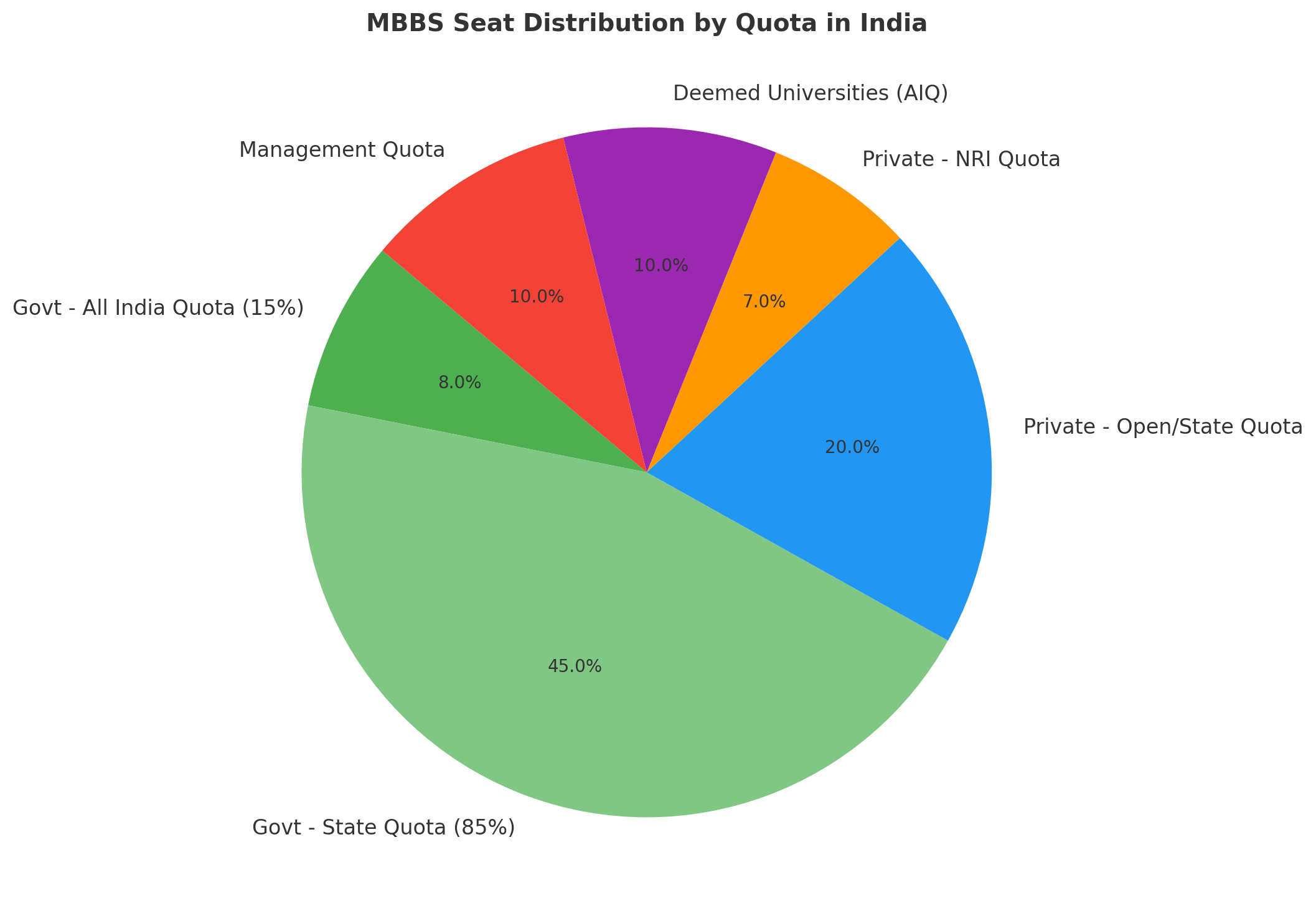
Seat allocation in MBBS admission is divided into multiple quotas for All India, state-level, category-based, management, and NRI admissions.
15% seats fall under the All India Quota, which is handled by MCC.
85% seats are reserved for state quota students through the respective state counselling authorities.
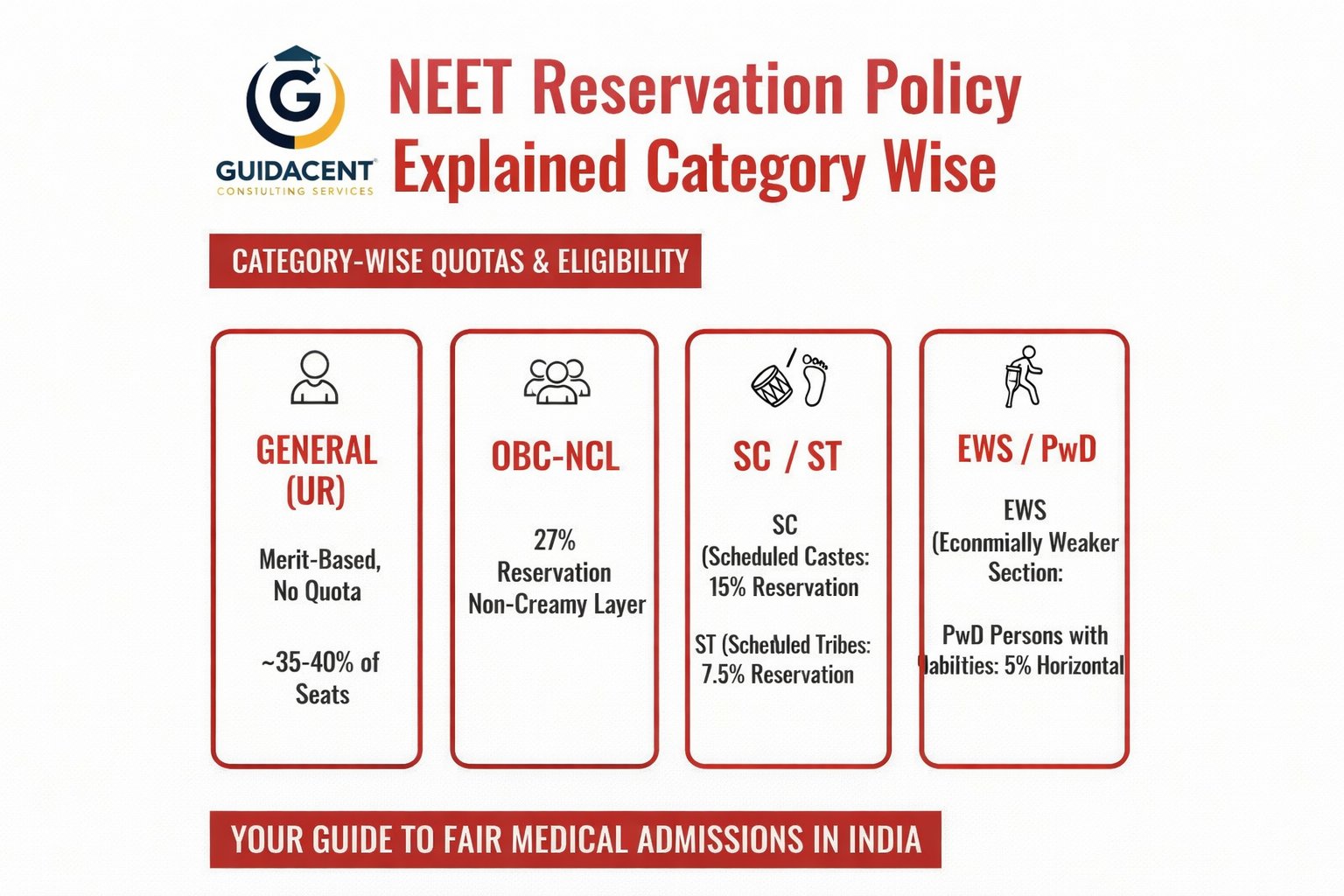
Additional reservations exist for SC, ST, OBC, EWS, and other eligible categories as per applicable rules.
Some seats are also allocated under management quota and NRI quota, depending on the college and counselling structure.
Direct MBBS Admission in India
Direct MBBS admission in India generally refers to admission to private or deemed medical colleges through management or NRI quota seats after qualifying NEET UG. All valid MBBS seats must be allotted through the applicable MCC or State NEET UG counselling process.
Students considering management or NRI quota options should verify eligibility, counselling rules, fees and the official seat matrix before making a decision.
Read Complete Direct MBBS Admission Guide →MBBS Admission Through Management Quota
MBBS admission through management quota is available in eligible private and deemed medical colleges for NEET-qualified candidates. Admission must be completed through the applicable NEET counselling process and is subject to eligibility, rank, seat availability and prescribed fees.
- NEET qualification is mandatory
- Seats are mainly available in private and deemed medical colleges
- Fees are generally higher than government quota seats
- Seat allotment must follow the applicable counselling process
For detailed eligibility, fees, counselling, seat options and admission guidance, read our complete guide on MBBS Admission Through Management Quota .
Which States Offer Better Private MBBS Opportunities?
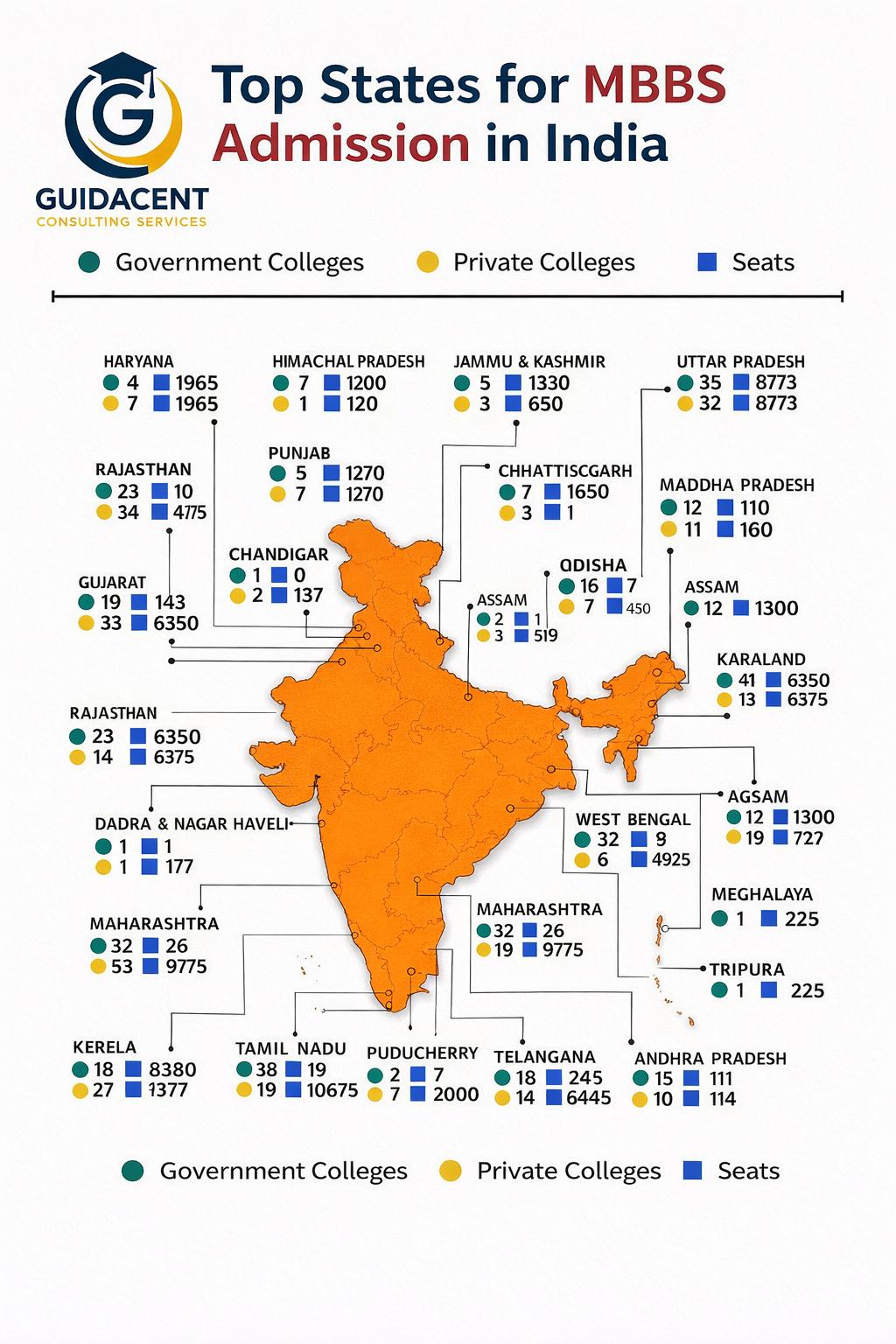
States like Karnataka, Tamil Nadu, Maharashtra, Rajasthan, and Uttar Pradesh offer significant private medical college opportunities because they have larger seat availability, multiple counselling rounds, broader college choices, and growing medical education infrastructure.
Top States for MBBS Admission in India
Choosing the right state is one of the most powerful strategies in MBBS admission. Certain states consistently offer higher seat availability, better counselling systems, and flexible admission options, which can improve your chances. States like Karnataka, Uttar Pradesh, Tamil Nadu, and Maharashtra remain popular choices for NEET aspirants.
Top States with Best MBBS Admission Opportunities
MBBS Fees Structure in India
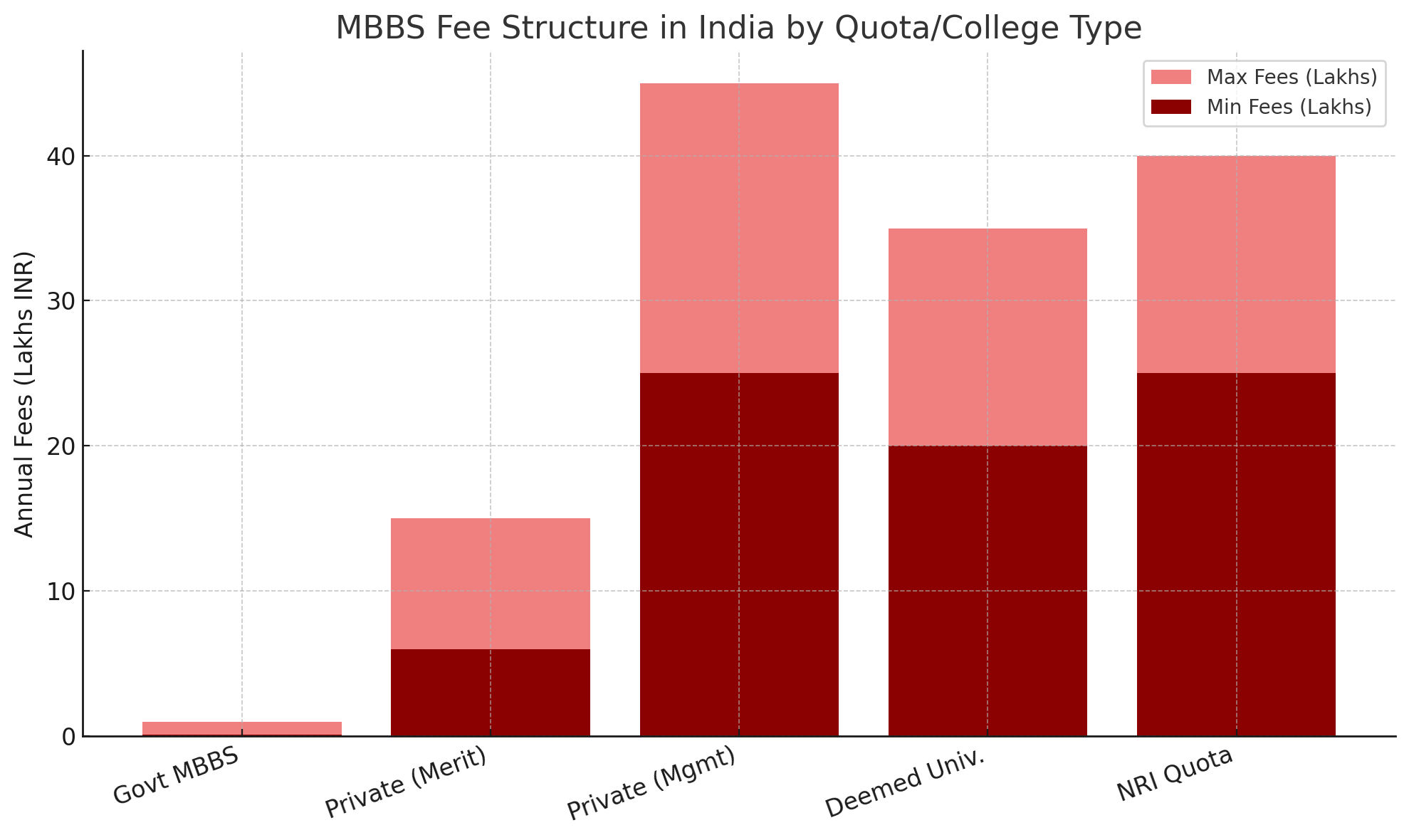
The MBBS fee structure in India varies widely based on the type of college and admission quota.
🏛️ Government Medical Colleges
₹10,000 – ₹1 lakh per year
🎓 Deemed Universities
₹15 lakh – ₹30 lakh per year
🏥 Private Medical Colleges
- State Quota: ₹50,000 – ₹6 lakh per year
- AIQ Quota: ₹12 lakh – ₹20 lakh per year
- Management Quota: ₹25 lakh – ₹40 lakh per year
- NRI Quota: ₹25 lakh – ₹40 lakh per year
MBBS Cutoff Trends (India)
MBBS cutoff trends in India change every year depending on factors such as the number of applicants, exam difficulty level, seat availability, and reservation policies. Since lakhs of students appear for NEET UG every year, even a small variation in performance can impact cutoff ranks and scores across states and colleges.
How MBBS Cutoffs Change Each Year
MBBS cutoff trends vary every year based on NEET competition, exam difficulty, and seat availability. Students should analyze previous trends, keep backup options ready, and explore alternative admission routes to improve their chances.
State-Wise MBBS Cutoff (Government Colleges – General Category)
| State | Closing Rank (Approx) | NEET Score Range (Approx) |
|---|---|---|
| Delhi | 500 – 5,000 | 650 – 710 |
| Rajasthan | 3,000 – 12,000 | 620 – 680 |
| Uttar Pradesh | 5,000 – 18,000 | 600 – 670 |
| Maharashtra | 8,000 – 25,000 | 580 – 650 |
| Karnataka | 15,000 – 40,000 | 520 – 620 |
| Tamil Nadu | 20,000 – 50,000 | 500 – 600 |
| Kerala | 10,000 – 35,000 | 540 – 630 |
| West Bengal | 12,000 – 40,000 | 520 – 610 |
| Madhya Pradesh | 18,000 – 45,000 | 500 – 590 |
| Bihar | 7,000 – 20,000 | 580 – 660 |
| Gujarat | 20,000 – 50,000 | 490 – 580 |
| Telangana | 25,000 – 60,000 | 470 – 560 |
| Andhra Pradesh | 30,000 – 65,000 | 460 – 550 |
| Chhattisgarh | 35,000 – 70,000 | 450 – 540 |
| Odisha | 25,000 – 60,000 | 470 – 560 |
Category-Wise MBBS Cutoff (Government Colleges – Trends)
| Category | Closing Rank (Approx) | NEET Score Range (Approx) |
|---|---|---|
| General (UR) | 500 – 25,000 | 580 – 710 |
| OBC | 2,000 – 35,000 | 550 – 680 |
| EWS | 1,500 – 30,000 | 560 – 690 |
| SC | 20,000 – 80,000 | 420 – 550 |
| ST | 40,000 – 1,20,000 | 350 – 500 |
| PwD | 50,000 – 1,50,000+ | 300 – 480 |
📊 Private Medical Colleges Cutoff (Approx Trends)
| State | Closing Rank (Approx) | NEET Score Range (Approx) | Quota Type |
|---|---|---|---|
| Karnataka | 40,000 – 1,50,000 | 350 – 520 | Management / Private |
| Tamil Nadu | 50,000 – 1,20,000 | 380 – 500 | State + Management |
| Maharashtra | 30,000 – 1,00,000 | 400 – 550 | State + Institutional |
| Telangana | 60,000 – 2,00,000 | 300 – 480 | Management |
| Andhra Pradesh | 70,000 – 2,20,000 | 280 – 460 | Management |
| Uttar Pradesh | 40,000 – 1,20,000 | 380 – 520 | Private |
| Madhya Pradesh | 60,000 – 1,50,000 | 350 – 480 | Private |
| Gujarat | 50,000 – 1,30,000 | 360 – 500 | State + Management |
| West Bengal | 45,000 – 1,20,000 | 380 – 520 | Private |
| Rajasthan | 35,000 – 1,00,000 | 400 – 550 | Private |
🎯 Understanding Private Medical College Cutoffs
Private medical colleges have significantly lower NEET cutoffs compared to government colleges. States like Karnataka, Telangana, and Andhra Pradesh offer more flexible admission options for low NEET scores through management quota seats.
NEET UG College Predictor
Check your MBBS admission chances based on NEET rank
Call/WhatsApp: 8000305060
Why Choose Guidacent
Choosing the right guidance partner can make a huge difference in MBBS admission success. With multiple counselling rounds and complex seat allocation, students often need clear and reliable support.
🎯 Expert MBBS Admission Counseling
Guidacent provides complete MBBS admission guidance from NEET analysis to final seat allotment.
- Personalized college prediction
- Counselling strategy (AIQ + State)
- Choice filling guidance
- Documentation support
🧠 12+ Years of Experience
With strong experience in education consulting, Guidacent understands changing cutoff trends, state-wise counselling systems, and private and deemed college admissions.
👉 This helps students make accurate and confident decisions.🤝 Why Students Trust Guidacent
- Medical and engineering admission expertise
- 5000+ students guided successfully
- Transparent counselling and genuine college information
- NRI and management quota seat support
- End-to-end help from counselling to admission
🚀 How Guidacent Helps You Get the Right MBBS Seat
- Score and budget analysis
- Realistic college shortlisting
- MCC and state counselling guidance
- Management and NRI quota planning
- Support until final college reporting
Conclusion: Your Path to MBBS Admission in India
MBBS admission in India is a competitive yet achievable journey when students follow the right strategy, proper guidance, and timely decision-making. From understanding NEET cutoffs and seat distribution to comparing fees and exploring alternative options, every step plays an important role in securing the right medical seat.
👉 Government seats are limited
👉 Cutoffs change every year
👉 Opportunities exist beyond top ranks
That is why students should stay flexible and make smart decisions based on realistic possibilities.
- Keep backup options ready
- Explore private, deemed, and management quota seats
- Compare India vs MBBS abroad options
- Make decisions based on rank, budget, and long-term goals
Secure Your MBBS Seat Now
Your dream of becoming a doctor is achievable with the right guidance. Whether your NEET score is high, average, or low, multiple MBBS admission options are still available.
- 👉 Don’t wait until seats are filled
- 👉 Don’t rely on guesswork during counselling
- 👉 Don’t risk losing a year due to wrong decisions
🎯 Get Expert MBBS Admission Guidance Today
📞 Call / WhatsApp: 8000305060
📩 Email: info@guidacentconsultingservices.com
- ✔ Personalized College Prediction
- ✔ State + AIQ Counselling Strategy
- ✔ Private / Deemed / Management Quota Guidance
- ✔ MBBS Abroad Options
- ✔ End-to-End Admission Support
⚡ Limited Seats | High Demand
Every year, many students miss MBBS admission due to lack of proper guidance.
👉 Talk to an expert now and secure your MBBS seat with confidence.
Written by
Sunny Yadav
Founder – Guidacent Consulting Services Pvt. Ltd.
12+ years experience in Engineering | Medical | Management | Admission Guidance in Top colleges of India & Abroad
Before making your final counselling choices, NEET UG Aspirants should also explore:
- How to Get MBBS Admission in India
- What Is MBBS Admission?
- Is NEET Mandatory for MBBS?
- Can I Get MBBS With Low NEET Score?
- MBBS Admission Through Management Quota
- Direct MBBS Admission in India
- Documents Required for MBBS Admission
- NRI Quota MBBS Admission
- MBBS Counselling Process Explained
- MBBS Admission Fees in India
- MBBS Cutoff Trends
- Best States for MBBS Admission
- Cheapest MBBS Colleges in India
- Government vs Private MBBS Colleges
- State-Wise MBBS Admission Guide