
NEET UG Attempt Limit: How Many Times Can You Appear?
Clear your doubts regarding the National Medical Commission (NMC) regulations, upper age limits, and total allowed attempts for medical aspirants.
Aspirants preparing for medical entrance examinations often ask whether taking another preparatory year will disqualify them from future tests. For parents and students planning their medical education, understanding the formal boundary rules is critical before committing emotional and financial resources to another attempt.
The regulations governing medical entrance eligibility have evolved significantly over recent years. While earlier entrance frameworks imposed caps on attempts and age, current National Medical Commission regulations provide clear parameters for candidates seeking medical seats.
Quick Answer
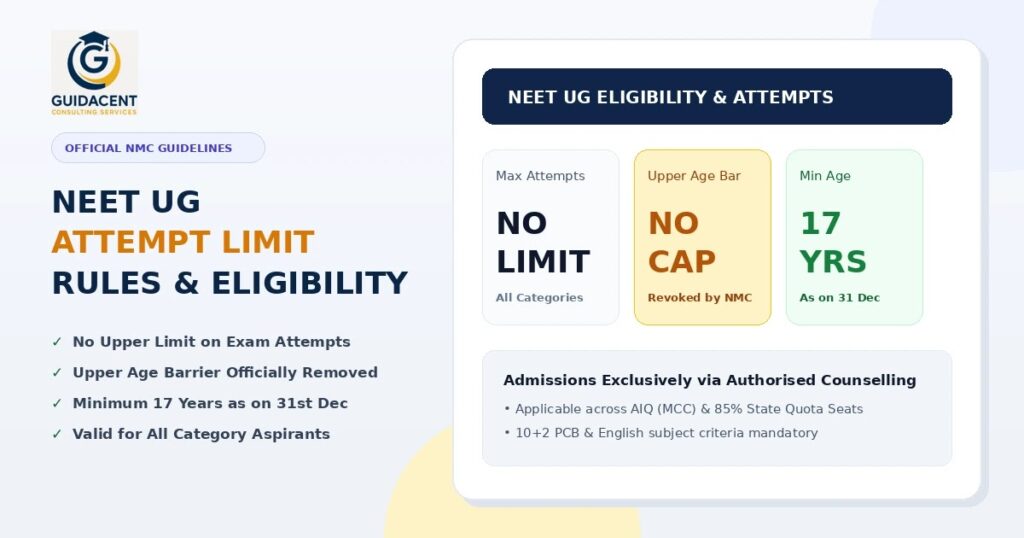
Under current National Medical Commission (NMC) regulations, there is no restriction on the number of attempts for NEET UG. Candidates may appear as many times as needed, provided they meet the minimum age criterion of 17 years by December 31 of the admission year and satisfy the basic qualifying subject requirements.
Key Takeaways
- ✓ No Attempt Limit: There is no upper limit on the number of times you can write the NEET UG examination.
- ✓ No Upper Age Bar: The upper age limit has been formally removed for all candidate categories.
- ✓ Minimum Age Requirement: Candidates must be at least 17 years old on or before 31 December of the admission year.
- ✓ 10+2 Eligibility Intact: Subject requirements (Physics, Chemistry, Biology/Biotechnology, and English) and minimum aggregate percentage criteria still apply.
- ✓ Strategic Planning: A structured counselling evaluation is recommended if repeated attempts do not yield significant score improvements.
Official Regulations on NEET UG Attempt Limit
According to directives issued by the National Medical Commission (NMC) and implemented by the National Testing Agency (NTA), the earlier restrictions on attempts have been completely eliminated. Aspirants across General, OBC, SC, ST, EWS, and PwD categories are legally permitted to sit for the examination without any attempt ceiling.
Historically, various caps were introduced and debated, including proposals limiting attempts to three. However, following regulatory decisions and directives from the Supreme Court of India, the UGMEB (Undergraduate Medical Education Board) under the NMC formalised policies ensuring that any eligible candidate can appear repeatedly until they achieve their target score.
While the entrance exam allows unlimited attempts, navigating the comprehensive MBBS admission in India counselling process (https://www.guidacentconsultingservices.com/mbbs-admission/) requires understanding seat matrices, state quotas, and institutional cutoffs to make effective use of your scores.
Understanding the Age Limit Criteria
Alongside the question of attempt limits, age restrictions are a common source of confusion among candidates planning gap years.
Minimum Age Requirement
A candidate must have completed a minimum of 17 years of age at the time of admission or must attain that age on or before 31 December of the calendar year in which admission to the UG medical course is sought.
Removal of the Upper Age Limit
The upper age restriction—previously set at 25 years for general category candidates and 30 years for reserved categories—was officially revoked by the NMC. As a result, there is no maximum age barrier to appear for NEET UG. Aspirants of any age above 17 can write the exam, provided they fulfill the required 10+2 academic qualifications.
NEET UG Attempt Limit & Eligibility Overview
A quick summary of key criteria across all reservation categories under National Medical Commission (NMC) guidelines.
| Parameter | General / EWS Category | OBC / SC / ST / PwD Category |
|---|---|---|
| Maximum Attempt Limit | No Limit | No Limit |
| Minimum Age Requirement | 17 years by 31 Dec of admission year | 17 years by 31 Dec of admission year |
| Upper Age Limit | No Upper Limit | No Upper Limit |
| Qualifying Subjects | Physics, Chemistry, Biology/Biotech, English | Physics, Chemistry, Biology/Biotech, English |
Academic Eligibility Rules to Remember
While attempt limits and upper age bars have been removed, students must still satisfy the core academic criteria established in the Regulations on Graduate Medical Education:
- Qualifying Examination: Passed 10+2 or equivalent with Physics, Chemistry, Biology/Biotechnology, and English as core subjects.
- Minimum Marks: Secured at least 50% aggregate marks in Physics, Chemistry, and Biology/Biotechnology for General/EWS candidates (40% for SC/ST/OBC and 45% for General-PwD).
- Mandatory Examination: Qualifying NEET UG is legally required for admission to all medical seats in India, including Government, Private, Deemed University, Management, and NRI quota seats.
Practical Impact of Multiple Attempts and Gap Years
Although the regulatory framework permits unlimited attempts, candidates and their families must evaluate the practical implications of taking multiple gap years.
Impact on Counselling and Seat Allotment
Central counselling authorities (such as the Medical Counselling Committee) and state counselling bodies allot MBBS seats solely on the basis of All India Rank (AIR), category, and candidate preference. A candidate who qualified on their third or fourth attempt receives the exact same institutional consideration as a first-time applicant with an identical rank. Counselling rules do not deduct marks or penalise candidates for gap years.
Document Requirements for Gap Years
Students who take one or more gap years after completing Class 12 must often provide a standard Gap Certificate (Affidavit) during state or institutional physical document verification. This non-judicial stamp paper document simply states the activities undertaken during the gap period (such as NEET preparation) and confirms that the candidate was not involved in unlawful activities.
Expert Counsellor’s Insight: Deciding on Another Attempt
The removal of the attempt limit provides flexibility, but repeating the exam requires an objective assessment. When deciding whether to drop another year, consider the following strategic checkpoints:
- Score Progression: Assess whether your score improved significantly between attempts. A plateau across multiple attempts often indicates the need to re-evaluate preparation methods or explore alternative medical pathways.
- Fee vs. Time Analysis: In some cases, securing a private or deemed university seat through authorised counselling in the current year may be more practical than spending additional years attempting to secure a government seat.
- Institutional Policies: Verify if any specific state quota rules or minority institutions have local documentation prerequisites before finalising your admission plan.
Common Mistakes to Avoid
- Believing Informal Rumours: Every year, unverified claims circulate regarding new attempt caps. Rely only on official gazettes and notices from the NTA or NMC.
- Overlooking Academic Eligibility: Assuming that passing NEET automatically guarantees eligibility, even if Class 12 aggregate marks in core subjects fall below the required threshold.
- Misinterpreting Quota Systems: Assuming that management quota seats bypass NEET. All legitimate management seats are allocated strictly through centralised or state counselling based on NEET merit.
- Delaying Gap Documentation: Waiting until the day of physical reporting to draft gap affidavits and character certificates required by specific medical colleges.
What Students Should Do Next
- Verify Current Information: Review the latest information bulletin on the official NTA NEET portal to verify current session rules.
- Audit Your Academic Marks: Ensure your 10+2 mark sheet meets the minimum percentage criteria set by the NMC for your category.
- Prepare Necessary Documentation: Keep Class 10 and 12 certificates, category certificates (if applicable), and identity proofs ready in official formats.
- Formulate a Counselling Plan: Map your realistic score range against historical closing ranks across Central, State, and Deemed university counselling rounds.
Official Regulatory Sources
Frequently Asked Questions
Is there any limit on NEET UG attempts for General category students?
No. There is no attempt limit for General category candidates. Under current National Medical Commission guidelines, students from all categories may attempt the examination as many times as necessary, provided they meet the minimum age and 10+2 academic criteria.
What is the maximum age limit to appear for NEET UG?
There is no maximum age limit. The NMC removed the upper age restriction for all candidates. Anyone who has completed 17 years of age by 31 December of the admission year and satisfies the required subject criteria can appear.
Do gap years affect MBBS admission during counselling?
No. Medical Counselling Committee (MCC) and state counselling authorities allocate seats purely on the basis of NEET UG merit ranks and preferences. Gap years do not result in negative marking or reduced priority during allotment.
Is a gap certificate mandatory for NEET repeaters?
Many state counselling bodies and individual medical colleges require repeaters to submit a simple gap affidavit during document verification. This affidavit confirms the reason for the gap (such as exam preparation) and verifies non-enrolment in unlawful activities.
Can I appear for NEET UG if I took Biology as an additional subject?
Under NMC guidelines and court rulings, candidates who have studied Biology/Biotechnology as an additional subject after passing Class 12 are generally permitted to appear, subject to meeting the overall qualifying criteria outlined in the official NTA bulletin.
Does qualifying NEET guarantee an MBBS seat?
No. Qualifying NEET UG merely establishes eligibility to participate in the counselling process. Seat allotment depends on your All India Rank, category, seat availability, and choices submitted during MCC or State counselling rounds.
Conclusion
Understanding the official NEET UG attempt limit allows aspirants to plan their medical careers without fear of arbitrary disqualification. With no upper age limit and no restriction on attempts, your focus can remain squarely on academic preparation and strategic counselling decisions. When evaluating multiple attempts, balance your preparation goals with a clear understanding of seat categories, state quotas, and private college alternatives to make an informed choice.
Written by
Ssunny Yadav
Founder – Guidacent Consulting Services Pvt. Ltd.
12+ year’s experience in Engineering | Medical | Management | Admission Guidance in Top colleges of India & Abroad