
NEET UG Age Limit Rules Explained: Minimum Age & Upper Limit Updates
Comprehensive guide to the latest National Medical Commission (NMC) age criteria, category-wise birthdate cutoffs, and attempt limits for MBBS, BDS, and AYUSH admissions.
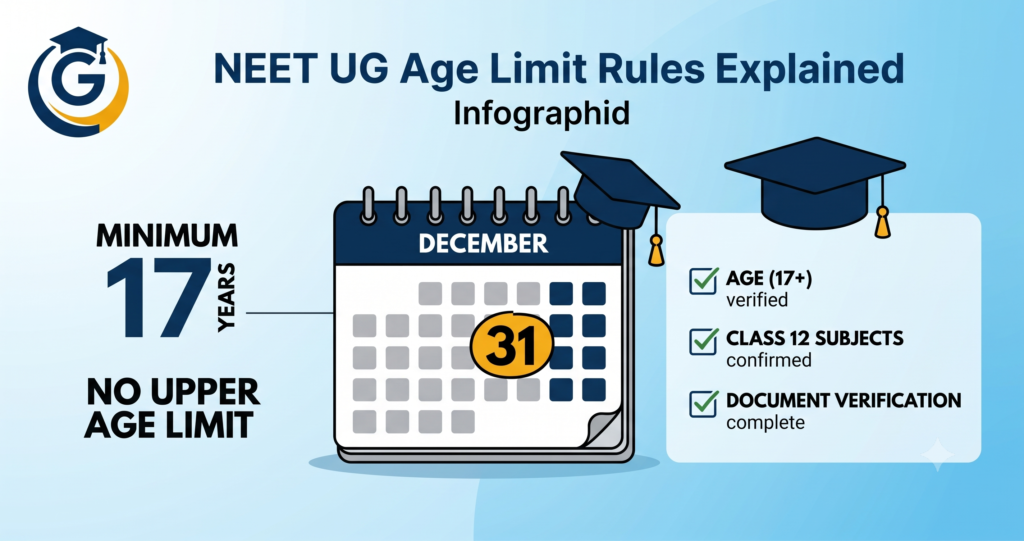
Every academic year, thousands of medical aspirants and their families encounter confusion regarding eligibility criteria before submitting entrance exam forms. Determining whether an applicant meets the birth-date cutoff or falls within permissible age thresholds remains a critical first step. For candidates planning their journey through the structured MBBS admission process in India, understanding regulatory age requirements prevents administrative disqualification during document verification.
Quick Answer
The minimum age to appear for NEET UG is 17 years completed on or before December 31 of the year of admission. There is currently no upper age limit for NEET UG; candidates of any age above 17 who meet academic subject requirements may appear and participate in counselling.
Key Takeaways
- ✔ Lower Age Cap: Candidates must turn 17 on or before December 31 of the examination/admission year.
- ✔ Upper Age Cap: The National Medical Commission (NMC) removed the upper age restriction in 2022, allowing candidates of any age above the minimum threshold to appear.
- ✔ Attempt Limits: There is no cap on the number of attempts permitted for NEET UG.
- ✔ Category Variations: While reservation categories receive concessions for qualifying marks, the lower age requirement of 17 years applies uniformly across all categories.
The Minimum Age Requirement for NEET UG
Under the Graduate Medical Education Regulations framed by the National Medical Commission (NMC), an applicant must have completed a minimum of 17 years of age at the time of admission or must complete that age on or before December 31 of the year of admission to the undergraduate medical course.
This cutoff date is statutory. Even if a candidate falls short of the 17-year threshold by a single day (for example, turning 17 on January 1 of the following calendar year), the National Testing Agency (NTA) application portal will not accept the registration for that academic cycle.
How the December 31 Cutoff Works in Practice
| Academic Session | Minimum Age Required | Decisive Cutoff Date | Born On or Before |
|---|---|---|---|
| NEET UG 2025 | 17 Years | December 31, 2025 | December 31, 2008 |
| NEET UG 2026 | 17 Years | December 31, 2026 | December 31, 2009 |
| NEET UG 2027 | 17 Years | December 31, 2027 | December 31, 2010 |
Is There an Upper Age Limit for NEET UG?
Historically, the Medical Council of India (now replaced by the National Medical Commission) maintained an upper age ceiling of 25 years for general-category applicants and 30 years for candidates belonging to SC, ST, OBC-NCL, and PwD categories. This restriction led to substantial litigation before various High Courts and the Supreme Court of India.
In March 2022, following formal communication from the NMC, the upper age limit for appearing in NEET UG was completely removed. As affirmed in subsequent regulatory updates, there is no maximum age limit. Candidates who completed their qualifying schooling years earlier, working professionals seeking a career transition into medicine, and multiple-attempt aspirants remain legally eligible to sit for the examination, provided they satisfy the mandatory subject criteria (Physics, Chemistry, Biology/Biotechnology, and English).
Number of Attempts Permitted
Along with the removal of the upper age cap, there is no restriction on the number of attempts a student can make for NEET UG. Aspirants can sit for the entrance exam as many times as needed, provided they qualify the minimum age cutoff and the relevant Class 12 board examination criteria specified by the NTA and NMC.
Category-Wise Age Concessions
A frequent area of confusion among parents is whether reserved categories (OBC, SC, ST, EWS, PwD) receive relaxations on the lower age limit. The lower age requirement of 17 years is universal across all categories, nationalities (including NRI, OCI, and foreign nationals), and quotas. Concessions for reserved categories apply strictly to qualifying percentile cutoffs and Class 12 aggregate percentages, not to the minimum age threshold.
Step-by-Step Decision Framework for Non-Traditional Aspirants
- Subject Eligibility Verification: Confirm that you completed regular or recognized board coursework in Physics, Chemistry, Biology/Biotechnology, and English.
- Core Document Reconciliation: Ensure that your Class 10 certificate, Aadhaar card, and passport reflect identical dates of birth.
- Gap Certificate Preparation: Many state counselling authorities require a formal gap affidavit during physical document verification to account for the years between Class 12 completion and medical admission.
- State Quota Domicile Rules: While age limits do not differ by state, individual state counselling bodies enforce specific local domicile and schooling rules that must be checked prior to registration.
Expert Counsellor’s Insight
Removing the upper age limit has provided valuable flexibility, but older candidates and multiple-dropper students must plan their counselling strategy carefully. While the NTA permits examination registration without age caps, state counselling authorities strictly scrutinize identity documents, gap affidavits, and migration certificates during institutional reporting. Ensure that all name spellings, parent details, and birth dates match across your Class 10 marksheet and government identification to avoid provisional rejections during seat allotment rounds.
Common Mistakes to Avoid
- Miscalculating the Birth Cutoff: Assuming that turning 17 during the exam month (typically May) is sufficient, rather than checking the mandatory December 31 milestone.
- Confusing Exam Eligibility with State Domicile Norms: Assuming that open national eligibility overrides specific state-level bond or service requirements applicable to candidates of varying profiles.
- Discrepancies in Supporting Proofs: Submitting birth certificates or school leaving records that contradict the date of birth listed on the Class 10 board certificate.
- Relying on Unofficial Rumours: Believing recurring social media claims regarding the reinstatement of the 25-year age cap without checking official NMC gazettes.
Official Sources
- • National Medical Commission (NMC) – Undergraduate Medical Education Board Regulations.
- • National Testing Agency (NTA) NEET Portal – Official Information Bulletins and Eligibility Guidelines.
- • Medical Counselling Committee (MCC) – Institutional Reporting and Allotment Directives.
What Students Should Do Next
Begin by checking your birth date against the Class 10 certificate to confirm you satisfy the 17-year threshold for your target admission year. Next, organize your qualifying mark sheets, category certificates (if applicable), and identity proofs well ahead of application deadlines. Because seat allotment in government, private, and deemed universities is conducted strictly via merit lists published by the Medical Counselling Committee (MCC) and State Counselling Directorates, track official portal notices regularly to align your strategy with current counselling schedules.
Frequently Asked Questions
Can a candidate who turns 17 on January 5 after the admission year apply?
No. The regulation mandates that the candidate must turn 17 on or before December 31 of the examination/admission year. Completing 17 years in January of the following year disqualifies the applicant for that specific academic session.
Is there an upper age limit for reserved category students?
No. There is no upper age limit for any category, including General, OBC, SC, ST, EWS, and PwD candidates. The removal of the maximum age cap applies universally across all applicant groups.
Does the number of drops affect MBBS counselling eligibility?
No. Counselling authorities do not penalize candidates for gap years or multiple exam attempts. As long as you qualify the entrance exam cutoffs and produce the required gap affidavits and academic certificates, seat allocation follows standard merit ranking.
Are private medical colleges allowed to enforce independent age limits?
No. All medical colleges in India, including private institutions and deemed universities, are governed by NMC regulations. They cannot set private age restrictions that diverge from national statutory guidelines.
Is the age eligibility criteria the same for BDS and AYUSH courses?
Yes. The minimum age requirement of 17 years completed on or before December 31 applies uniformly to allied undergraduate medical courses, including BDS, BAMS, BHMS, and BUMS admissions governed through NEET qualification.
Conclusion
The rules governing the NEET UG age limit are straightforward: candidates must meet the minimum age requirement of 17 years by December 31 of the admission year, while no upper age limit restricts aspirants from pursuing their medical education. By verifying documentation early and adhering to official guidelines, applicants can approach their medical entrance journey with clarity and confidence.
Need Personalised MBBS Admission Guidance?
Speak with Guidacent Consulting Services for expert assistance with NEET score analysis, college shortlisting, counselling strategy, fee comparison, and document verification.
Written by
Ssunny Yadav
Founder – Guidacent Consulting Services Pvt. Ltd.
12+ year’s experience in Engineering | Medical | Management | Admission Guidance in Top colleges of India & Abroad