
Karnataka NEET Closing Rank 2026: Round 1 Cutoffs & College-Wise Analysis
Explore institute-wise opening and closing ranks, category cutoffs, and comprehensive seat allotment trends for Karnataka medical admissions.
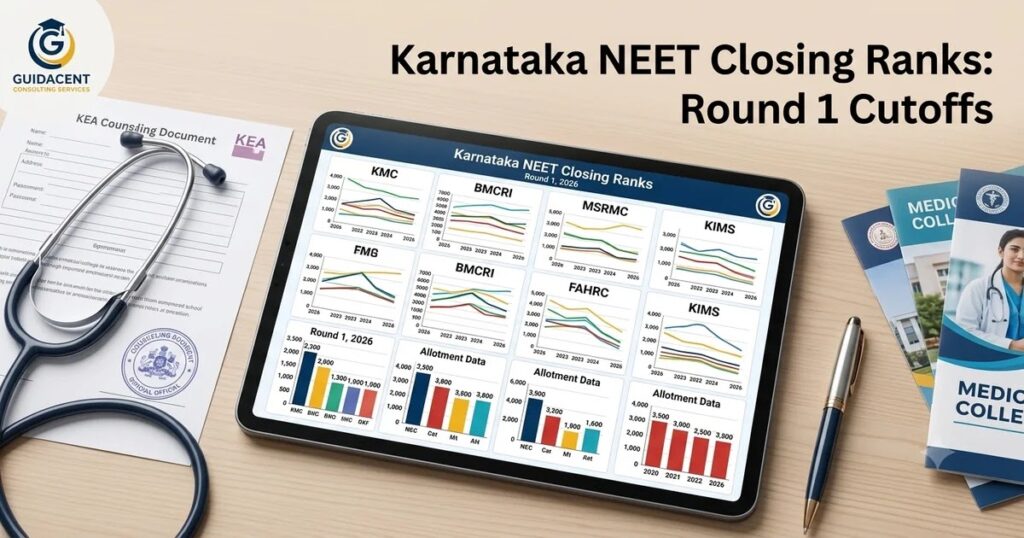
Specific Visual Concept: A modern, clean counseling analytics workspace visual featuring a digital tablet displaying an organized matrix of medical colleges, rank cutoff graphs, a stethoscope, and an official counseling document outline. Subtle Guidacent brand emblem in the lower right corner.
Introduction:
Every year, thousands of medical aspirants across India closely track the Karnataka Examinations Authority (KEA) counseling schedule. Securing an MBBS seat requires a realistic assessment of rank cutoffs across diverse institutional categories. Understanding the Karnataka NEET closing rank 2026 patterns for Round 1 allows students and parents to evaluate where their NEET All India Rank (AIR) stands relative to historical allotments and make informed decisions during option entry.
Because Karnataka offers a mix of premier government institutes, long-established private trust hospitals, and state-of-the-art deemed universities, Round 1 cutoffs often exhibit high competitiveness. Strategic choice filling requires analyzing how ranks shift between state domicile quotas and open private seats.
Quick Answer: Understanding Round 1 Karnataka NEET Closing Ranks
Round 1 closing ranks in Karnataka represent the last NEET All India Rank (AIR) allotted a seat in a specific college and category during the initial allotment phase conducted by the Karnataka Examinations Authority (KEA).
*Exact cutoffs vary based on seat matrix, quota type (Government, Private, NRI, Others), and annual fee structures.
Key Takeaways for KEA NEET UG Round 1
-
Baseline Benchmark: Round 1 sets the initial cutoff standard for MBBS seat allocation across government, private, and minority colleges across Karnataka.
-
Quota Discrepancies: Cutoffs diverge significantly between Karnataka Domicile seats (G-Quota), Open/Non-Karnataka seats (P-Quota), and Institutional/Management quotas (Q-Quota).
-
Upgradation Flexibility: Securing an initial seat is not final; eligible candidates can exercise choice options to retain their allotted seat while participating in Round 2 for an upgrade.
-
Annual Variations: Final closing ranks fluctuate annually depending on candidate performance curves, seat matrix revisions, and official fee revisions.
OVERVIEW OF KEA SEAT QUOTAS AND ALLOTMENT MECHANICS
Karnataka state counseling handles seat allocation under distinct quota classifications. To interpret closing rank trends accurately, candidates must identify which seat type aligns with their eligibility:
1. Government Seats in Government Colleges (A-Quota / GM): Reserved strictly for Karnataka domicile candidates meeting specific nativity and study criteria. These carry nominal government-regulated fee structures and have the most competitive closing ranks.
2. Government Quota Seats in Private Colleges (G-Quota): Subsidized seats in private medical colleges reserved for Karnataka domicile candidates based on state merit rankings.
3. Private / Open Quota Seats (P-Quota): Open to candidates across India without domicile restrictions. These seats are allotted strictly by NEET All India Rank, but carry standard private college tuition fees.
4. Other / Management Quota (Q-Quota) & NRI Quota (N-Quota): Open seats allotted through the centralized KEA portal at higher institutional fee bands.
When shortlisting institutions, students often prioritize established centers across the state capital. Reviewing details regarding private and government MBBS colleges in Bangalore helps establish how regional preference impacts opening and closing ranks during Round 1.
INDICATIVE ROUND 1 CLOSING RANKS FOR TOP KARNATAKA MEDICAL COLLEGES
(Note: Official 2026 counseling cutoff data will be issued by KEA upon the conclusion of Round 1 allotment. The data below reflects historical General Merit (Karnataka Quota) and Open Quota benchmarks from recent counseling sessions to provide an indicative baseline. These figures should be used for counseling trend analysis only.)
Karnataka NEET UG Round 1 Expected Closing Ranks (College-Wise)
Comparative closing rank trends across Government (G-Quota) and Private Open (P-Quota) seats.
| Medical College | Type | Govt. Quota / GM (G-Quota) | Private Open (P-Quota) |
|---|---|---|---|
| Bangalore Medical College & Research Institute (BMCRI) Bengaluru | Government | 2,500 – 4,200 | N/A (State Quota Only) |
| Mysore Medical College and Research Institute (MMCRI) Mysuru | Government | 5,500 – 8,900 | N/A (State Quota Only) |
| St. John’s Medical College Bengaluru | Private | 12,000 – 18,500 | 10,500 – 16,000 |
| MS Ramaiah Medical College Bengaluru | Private | 16,000 – 24,000 | 30,000 – 48,000 |
| Kempegowda Institute of Medical Sciences (KIMS) Bengaluru | Private | 22,000 – 32,000 | 42,000 – 65,000 |
| Father Muller Medical College Mangalore | Private | 30,000 – 42,000 | 50,000 – 72,000 |
| JJM Medical College Davangere | Private | 35,000 – 48,000 | 60,000 – 85,000 |
| Dr. BR Ambedkar Medical College Bengaluru | Private | 40,000 – 58,000 | 70,000 – 98,000 |
Download Official KEA NEET UG 2026 Round 1 Allotment PDF
Review the comprehensive seat allotment list released by the Karnataka Examinations Authority (KEA)[cite: 1]. This official document includes candidate-wise All India Ranks (AIR), category reservations (GM, 2A, 3B, SC, ST), applicable tuition fees, and institute codes across all government and private medical colleges in Karnataka[cite: 1].
FACTORS INFLUENCING THE KARNATAKA NEET CLOSING RANK 2026
Cutoffs are not static numbers; they fluctuate every session based on key variables:
– NEET Marks vs. Rank Inflation: Even if a candidate scores high absolute marks, changes in the overall NEET rank list determine exact eligibility within KEA lists.
– Seat Matrix Additions: Approval of new seats or colleges by the National Medical Commission (NMC) before Round 1 seat matrix publication broadens rank cutoffs.
– Fee Revision Orders: State government fee fixation notifications directly influence private quota cutoffs. Significant fee adjustments often cause ranks to shift lower down the percentile spectrum.
– Candidate Retention in MCC AIQ: Aspirants holding top ranks frequently wait for Round 2 of All India Quota (AIQ) counseling before finalizing their state seats, leaving room for rank movements across subsequent rounds.
EXPERT COUNSELLOR’S INSIGHT: CRAFTING A SAFE OPTION ENTRY STRATEGY
One of the most frequent errors made during KEA Round 1 is submitting a restrictive option entry list. Candidates often enter only three or four high-demand colleges, assuming lower choices can be added later without consequence.
In KEA counseling, prioritizing choices logically from top-tier aspirational colleges down to reliable baseline institutions is essential. Round 1 gives you a clear platform: if allotted an acceptable seat, you can choose Choice 2 (holding the allotted seat while participating in Round 2 for higher preferences). Without a strategic mix of colleges across realistic rank tiers, a candidate risks receiving no allotment in the primary round, missing out on valuable seat security.
COMMON MISTAKES TO AVOID IN KEA MBBS COUNSELING
– Confusing College Preferences with Merit Odds: Option entry should always reflect true institutional preference, not an assumption of where your rank belongs. KEA’s automated algorithm checks choices sequentially from top to bottom.
– Ignoring Fee Structures: Adding private, minority, or management quota seats without verifying the mandatory annual tuition and bank guarantee rules can lead to seat forfeiture if fees cannot be arranged.
– Failing to Complete Document Verification: Karnataka counseling requires strict adherence to offline or online verification schedules to generate the mandatory Secret Key and Verification Slip.
– Misunderstanding KEA Choices: Selecting the incorrect post-allotment choice (Choice 1, Choice 2, Choice 3, or Choice 4) can result in inadvertent cancellation of your seat or complete disqualification from subsequent rounds.
WHAT STUDENTS SHOULD DO NEXT
1. Download the Official KEA Verification Slip: Ensure your verified category, sub-category, and eligibility status appear correctly on the portal.
2. Review Previous Session Rank Lists: Analyze 2-year closing rank trends across your preferred medical colleges as an indicative benchmark.
3. Prepare a Tiered Option List: Divide your choices into “Dream Colleges” (higher cutoff than your rank), “Realistic Colleges” (within your rank range), and “Safe Colleges” (ranks closing well below your score).
4. Monitor Official Portals: Track schedule updates, seat matrix documents, and circulars directly from official state authority websites.
Official Reference Sources & Portals
All cutoff figures, seat matrices, and counselling schedules are referenced from official regulatory bodies. Verify authentic notices directly via the portals below:
- Karnataka Examinations Authority (KEA) Official State Counselling Portal, Seat Matrix & Allotment NotificationsVisit KEA Portal
- National Testing Agency (NTA NEET) NEET UG Examination Results, Official Scorecards & Percentile DataVisit NTA Portal
- National Medical Commission (NMC) Approved Medical College Lists, Intake Capacity & Recognition StatusVisit NMC Portal
- Medical Counselling Committee (MCC) Centralized AIQ (15%), Deemed Universities & Central Institute GuidelinesVisit MCC Portal
FREQUENTLY ASKED QUESTIONS
Q1: What is meant by Karnataka NEET closing rank 2026 in Round 1?
A1: The closing rank indicates the last NEET All India Rank that received a provisional seat allotment in a specific medical college, quota, and category during the first round of KEA counseling. It serves as a benchmark for assessing admission competitiveness across colleges.
Q2: Can non-Karnataka students participate in KEA MBBS counseling?
A2: Yes. Non-Karnataka candidates are eligible for the Open Quota (P-Quota), Management Quota (Q-Quota), and NRI Quota (N-Quota) seats in private medical colleges. They are not eligible for government quota seats or seats in state-run government medical colleges.
Q3: What happens if I do not get allotted a seat in KEA Round 1?
A3: If you are not allotted a seat in Round 1, you automatically proceed to Round 2. You will have the option to modify, reorder, delete, or add eligible choices before the Round 2 allotment process begins.
Q4: Is the Round 1 closing rank higher or lower than Round 2?
A4: Typically, Round 1 closing ranks are more competitive (closer to lower numerical ranks) than Round 2. As higher-ranking candidates vacate state seats for All India Quota seats or top institutes, cutoffs generally relax (open to higher rank numbers) in subsequent rounds.
Q5: Do private medical colleges in Karnataka require a bank guarantee?
A5: Certain private institutions and deemed universities may require a bank guarantee or undertaking for subsequent years’ tuition fees at the time of admission. Candidates must check the specific college prospectus and KEA fee orders prior to option entry.
CONCLUSION
Navigating the Karnataka NEET closing rank 2026 dynamics requires careful evaluation of merit ranks, category reservations, and individual college preferences. By analyzing Round 1 trends objectively and setting up a structured option entry hierarchy, candidates can maximize their chances of securing an MBBS seat in an institution that aligns with their academic and clinical career goals.
Written by
Ssunny Yadav
Founder – Guidacent Consulting Services Pvt. Ltd.
12+ year’s experience in Engineering | Medical | Management | Admission Guidance in Top colleges of India & Abroad